About Daboia palaestinae (Werner, 1938)
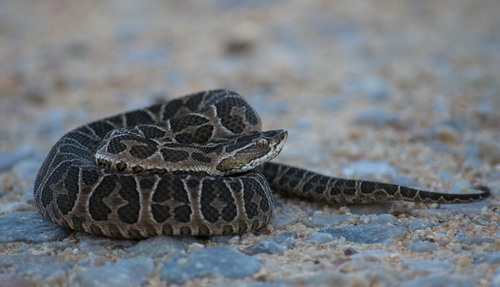
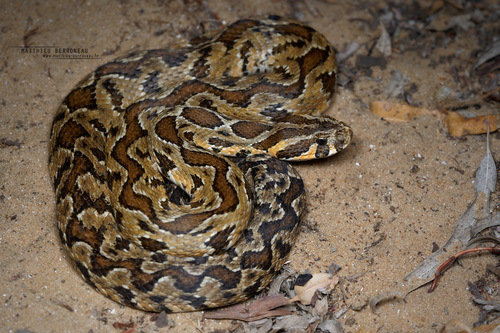
Daboia palaestinae, commonly known as the Palestine viper, reaches an average total length (including body and tail) of 70 to 90 cm (28 to 35 in), with a maximum recorded total length of 130 cm (51 in). Its head is triangular, clearly distinct from the neck, and covered in small scales. The dorsal (upper) surface of the body has large, dark rhomboid blotches, which sometimes form a zig-zag pattern. The harmless coin-marked snake, which shares the same geographic range as the Palestine viper, resembles this viper in length, coloration, and defensive behavior so closely that people often confuse the two species. This is likely an example of Batesian mimicry.
This viper is found in northern and central Israel, Palestine, western Syria, northwestern Jordan, and Lebanon. A single specimen was discovered in Turkey in 2017. Mallow et al. (2003) describe the species' range as relatively restricted, with its distribution concentrated on Mediterranean coastal plains extending to the inland hills of Lebanon and Israel, including the adjacent regions of Syria and Jordan. The species' type locality is recorded as "Haifa, Israel".
Copulation for this species occurs around May. Unlike most other vipers, which are viviparous (give birth to live young), Daboia palaestinae is oviparous (lays eggs). It lays its eggs around August, and the eggs hatch 1.5 to 2 months after being laid. Hatchlings already have a fully developed venom apparatus, and are capable of biting and killing prey.