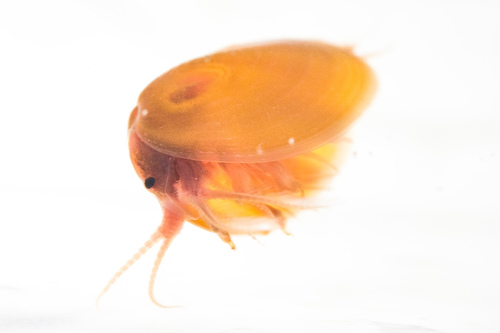
About Cyzicus californicus (Packard, 1874)
Cyzicus californicus is approximately 0.45 inches (11 mm) long, 0.11 inches (2.8 mm) wide, and 0.31 inches (7.9 mm) high. It has a flattened shell whose width is only 20% of its length. This narrow shell shape is similar to species in the genus Limnadia, and sets it apart from the much wider shells of Cyzicus morsei and Cyzicus elongatus. When viewed from the front, its shell is nearly triangular. The umbones – the first-formed part of the shell – are relatively small, and positioned above the animal’s head. The dorsal (top) side of the shell is curved, which further distinguishes this species from C. elongatus, which has a straight dorsal shell margin. The sides of the shell are smooth and reflective, marked with around 18 growth lines and a pattern of small bumps, also called granulations. This species has a relatively wide, short rostrum, a relatively wide telson, and relatively long antennae. Spines are found on the rearmost 16 to 18 body segments. Cyzicus californicus shows some sexual dimorphism: males have spatula-shaped structures on the left and right sides of their heads. Cyzicus californicus is estimated to occupy a total area of between 5,000 and 20,000 km² (1,900 to 7,700 mi²). Its range covers the entire Californian Central Valley and Coast Ranges, and may extend into southern Oregon. While this occupied area is much larger than that of other Californian branchiopods, the species remains rare across its entire range. Its natural habitat faces strong pressure from land development, but the species also occurs in protected artificial refugia. It lives in relatively deep water within seasonal wetlands such as vernal pools, and also occurs in artificial water bodies including ditches and stock ponds. It may share its habitat with other branchiopod species, including Branchinecta conservatio. Among large Californian branchiopods, Cyzicus californicus has a comparatively slow life cycle. In experimental pond conditions, C. californicus individuals took an average of 50 days from hatching to reach maturity. Reproduction was observed an average of 7 days after maturation. On average, populations survived for 156 days, until the seasonal pools they inhabited dried up.

