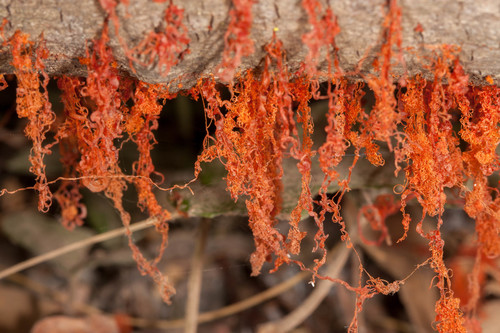
About Cytospora chrysosperma (Pers.) Fr.
Diamond willow refers to willow wood that has developed into alternating colored, diamond-shaped segments. The most common willow species that forms diamond willow is Salix bebbiana, which is indigenous to Canada and the northern United States, ranging from Alaska and Yukon south to California and Arizona, and northeast to Newfoundland and New England. Common names for Salix bebbiana include beaked willow, long-beaked willow, gray willow, and Bebb's willow. According to Ernest Thompson Seton's The Arctic Prairies Appendix E, this species is also called red willow by Native Americans. The diamond-shaped formations are caused by fungi, including Valsa sordida and potentially other species. The fungus that causes diamonding, known as diamond willow fungus, is recorded to have medicinal properties, and is used for both medicinal and ceremonial purposes as a 'sacred medicine' by First Nations. Diamond willow is valued by wood carvers and furniture makers for its strong contrasting red and white colors and its irregular, sculptural shape. At least six different willow species have been identified as susceptible to diamonding: the most common Salix bebbiana, plus S. pseudomonticola, S. arbusculoides, S. discolor, S. scouleriana, and S. alaxensis. Diamonding most often occurs with a branch at its center, or in the Y-junction of a tree. Diamonding in willows does not appear to be tied to a specific growing region; one clump of willows may have diamond formations, while the next adjacent clump may have none. Although diamond willow is often considered a northern phenomenon found in boreal forest, there are records of it growing as far south as Missouri.

