About Cytisus scoparius (L.) Link
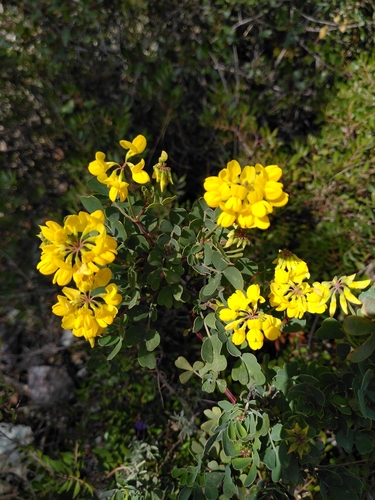
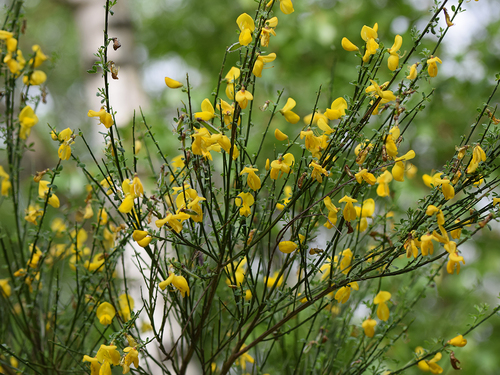
Cytisus scoparius (L.) Link is a shrub species that typically reaches 1 to 3 metres (3+1⁄2–10 feet) in height, and rarely grows up to 4 m (13 ft) tall. Its main stems are usually up to 5 centimetres (2 inches) thick, and occasionally reach 10 cm (4 in) thick. The stems are green and ridged. This shrub produces green shoots that bear small, deciduous trifoliate leaves, which measure 5–15 millimetres (1⁄4–5⁄8 in) long. In spring and summer, the plant is covered in abundant golden yellow flowers; each flower is 20–30 mm (3⁄4–1+1⁄8 in) long from top to base and 15–20 mm wide. Flowering begins after the plant accumulates 50–80 growing degree-days. Its leguminous seed pods only have long hairs along their seams. By late summer, the seed pods mature to a black colour, and measure 2–3 cm (3⁄4–1+1⁄4 in) long, 8 mm (3⁄8 in) broad, and 2–3 mm thick. Mature pods burst open, often with an audible cracking sound, to forcefully eject seeds away from the parent plant. This species is adapted to Mediterranean and coastal climates, and its natural range is limited by cold winter temperatures. It can also adapt to windy oceanic climates. Seeds, seedlings, and young shoots of C. scoparius are sensitive to frost, while adult plants are hardier; branches damaged by freezing temperatures can regenerate quickly. C. scoparius contains toxic alkaloids that depress the heart and nervous system. As a legume, this shrub can fix nitrogen in soil through a symbiotic relationship with Rhizobium bacteria. Cytisus scoparius is native to western and central Europe, and is common in Great Britain and the Republic of Ireland. It grows in sunny locations, most often on dry, sandy soils at low altitudes, and can tolerate very acidic soil conditions. Outside of its native range, it is an ecologically destructive colonizing invasive species in grassland, shrubland, woodland, and other habitats. Cytisus scoparius is widely cultivated as an ornamental plant. Several cultivars have been selected for variation in flower colour, including 'Moonlight' with deep yellow flowers, 'Andreanus' and 'Firefly' with dark orange-red flowers, and for variation in growth habit, including 'Pendula' with pendulous branchlets. Broom (Cytisus scoparius) contains scoparin, a diuretic compound. The plant is also used as a cathartic and a cardiac stimulant, properties attributed to the presence of sparteine. A decoction or infusion of broom can be used to treat dropsy, due to its diuretic action. An ointment made from the flowers can be used to treat gout. Oxysparteine, produced by treating sparteine with acid, is useful as a cardiac stimulant, and has the advantage over digoxin of not accumulating in the body. A medicinal beer called broom ale has been brewed from this herb to treat dropsy.