About Cytisus multiflorus (L'Hér.) Sweet
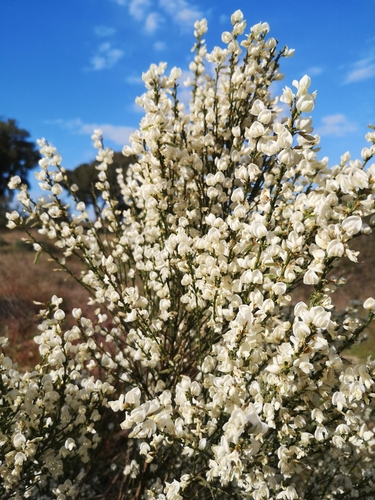
Cytisus multiflorus is a sprawling shrub that reaches between 0.8 meters (2 feet 7 inches) and 1.5 meters (4 feet 11 inches) in height. It has a broom-like arrangement of numerous five-angled flexible branches. Leaves grow mostly on the lower branches, and each of these leaves is composed of three leaflets. A smaller number of leaves grow on upper branches, and these usually consist of a single leaflet. Every leaflet is less than one centimeter long, ranges in shape from linear to oblong, and is covered in soft silvery hairs. Its flowers are white, pea-shaped, up to one centimeter long, and often have a dark pinkish streak near the base. The fruit of Cytisus multiflorus is a hairy legume pod that grows up to 3 centimeters (1.2 inches) long. As the pods age, they turn black and split open explosively to release their four to six seeds, dispersing them away from the parent plant. This species is native to the Iberian Peninsula. It is especially common in the western half of the region, occurring in central and northern interior Portugal, and central and northwestern Spain. It is more widely known as an introduced species on other continents, including Australia and North America. In these areas, it has become a weed in agricultural land and an invasive species in natural habitats.