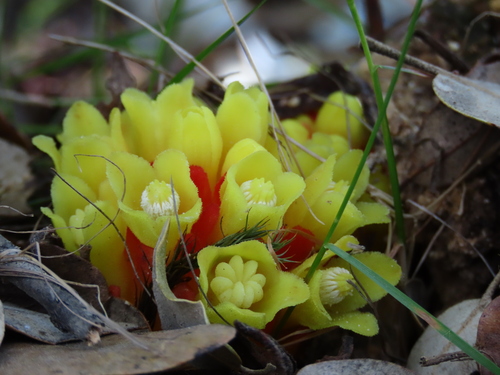
About Cytinus hypocistis (L.) L.
Cytinus hypocistis (L.) L. is an endophytic root holoparasite that lacks chlorophyll, external roots, leaves, and stems. This perennial species spends most of its life entirely inside the root tissue of its host, and only its flowers emerge from the host root to be visible above ground during the reproductive season. Its sweet-scented above-ground inflorescence is visited by many ant species, which act as pollinators for the plant. This species is native to Albania, Algeria, Crete, Croatia, Cyprus, Greece, France (including Corsica), Palestine, Italy (including Sardinia and Sicily), Lebanon, Libya, Malta, Morocco, Portugal, Spain (including both the Balearic and Canary Islands), Syria, Tunisia, and Turkey. Three subspecies have distinct native ranges: the subspecies C. h. subsp. macranthus is native to Portugal and western Spain; C. h. subsp. orientalis is native to southern Greece and Crete; and C. h. subsp. pityusensis is endemic to Ibiza in the Balearic Islands. Cytinus hypocistis grows inside the roots of its host plants, drawing all of its water and nutrients from the rock-roses it infests. When it parasitizes white rockroses (Cistus albidus), the nutrient uptake causes negative impacts to the host's productivity, seed viability, and overall reproductive ability. Tenebrionid beetles (Pimelia costata) disperse the species' seeds: they ingest the seeds, then excrete them in favorable underground locations for germination. Cytinus hypocistis has been used in traditional medicine to treat dysentery and throat tumors, and it has also been used for its astringent properties.

