About Cyrtostylis robusta D.L.Jones & M.A.Clem.
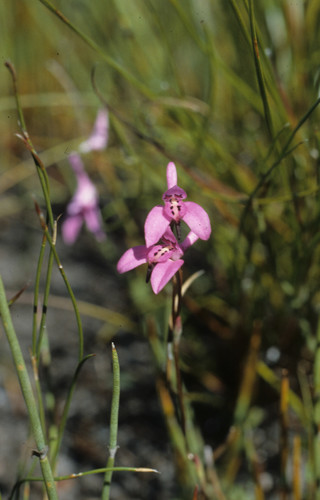
Cyrtostylis robusta is a terrestrial, perennial, deciduous herb that produces a single heart-shaped, kidney-shaped, or almost round leaf. The leaf measures 16–60 mm (0.6–2 in) long and 20–40 mm (0.8–2 in) wide, with a light to medium green upper surface and silvery lower surface. Between two and seven pinkish red flowers are borne on a flowering stem 40–300 mm (2–10 in) high. Each flower is 10–20 mm (0.4–0.8 in) long and about 6 mm (0.2 in) wide. Each pedicel is 5–11 mm (0.2–0.4 in) long, with a bract at its base. The dorsal sepal is erect, curves forward, and is linear but tapered, measuring 10–13 mm (0.4–0.5 in) long and about 2.5 mm (0.1 in) wide. The lateral sepals are linear, 10–11 mm (0.39–0.43 in) long and 1 mm (0.04 in) wide, and curve forwards or downwards. The petals match the lateral sepals in size and shape, and curve forwards or slightly downwards. The labellum is oblong, 10–15 mm (0.4–0.6 in) long and 4–6 mm (0.16–0.24 in) wide, slopes slightly downwards, and has a few serrations near its pointed tip. Flowering occurs from May to October. This species is similar to C. huegelii found in Western Australia, but it usually produces fewer, more brightly-coloured flowers with a wider labellum. In South Australia, it can be distinguished from the similar C. reniformis, which has more heavily veined leaves that are green on the lower side. Common name large gnat orchid, this orchid occurs in southern Victoria, where it grows in coastal scrub and forest. It is also found in south-eastern South Australia, including Kangaroo Island, and in Tasmania. It is most common and widespread in the south-west of Western Australia, where it grows in near-coastal shrubland, woodland and forest between Perth and Israelite Bay.