About Cyrtopleura costata (Linnaeus, 1758)
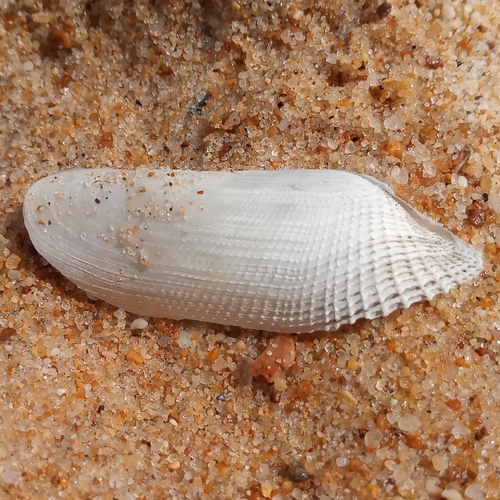
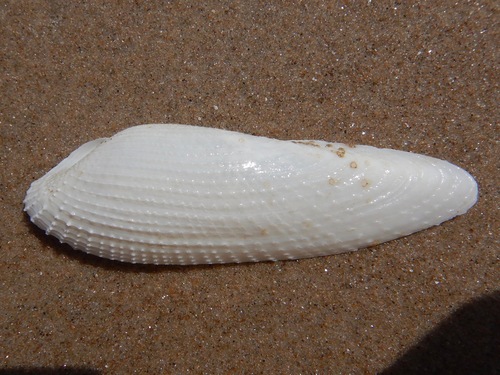
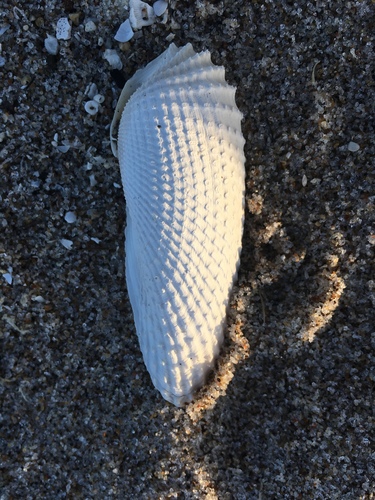
Cyrtopleura costata has a pair of brittle, asymmetric white valves, and can grow to about 7 inches (180 mm) in length. Its anterior end is elongated, with a rounded point used for digging through substrate. The posterior end is truncated and rounded; near the beak, it has an apophysis, a wing-like flange that provides an attachment point for foot muscles. On the anterior side of the beak, the valve margin is smooth and bent slightly upwards. The entire valve has finely sculptured radial ribs that intersect with a series of concentric growth rings running parallel to the valve margin. In living individuals, the valves are covered by the periostracum, a thin grey protective protein layer that forms part of the shell. By the time empty shells wash up on beaches, this layer has usually been stripped away by sand and surf, and valves are typically found singly, because the muscles that hold them together are weak. Internally, the live mollusc has a powerful muscular foot and a pair of long, fused siphons. These siphons cannot retract back into the shell, so the two valves remain permanently gape apart. Cyrtopleura costata occurs in shallow seas in the northeast Atlantic Ocean, ranging between Cape Cod and the Gulf of Mexico. It is also found in the West Indies, Central America, and extends as far south as Brazil. It is most common in the intertidal zone and just below the low water mark. This species is used as food in Cuba and Puerto Rico. It is a fast-growing species, and has been investigated for potential use in commercial aquaculture. Under optimal conditions, larvae are ready to undergo metamorphosis after 12 days, and settlement can be triggered by a dilute solution of epinephrine. The clams can reach a marketable size of 6 centimetres (2.4 in) within 6 months.