About Cyrtophora exanthematica (Doleschall, 1859)
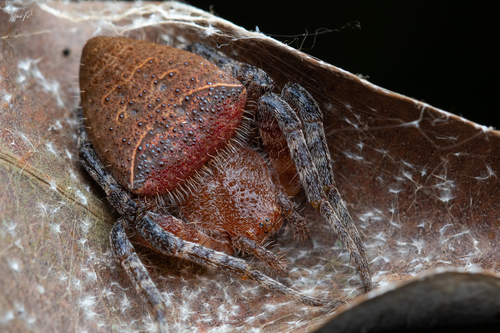
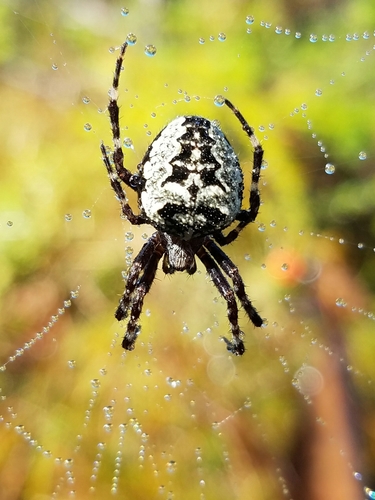
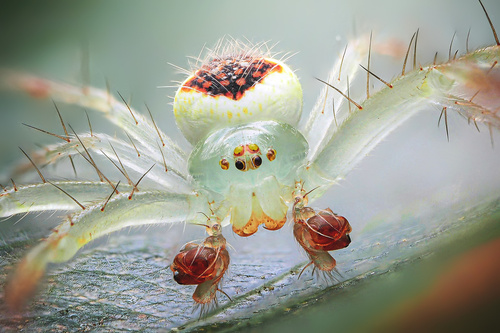
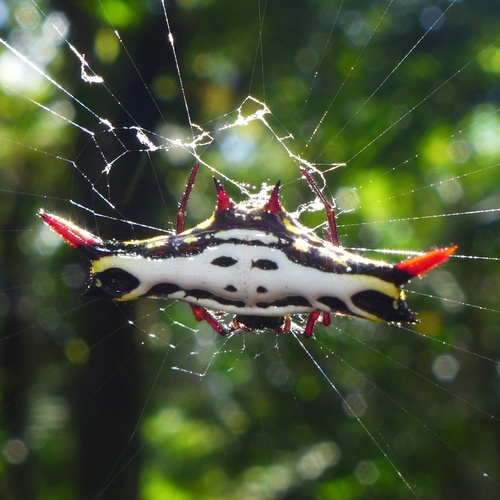
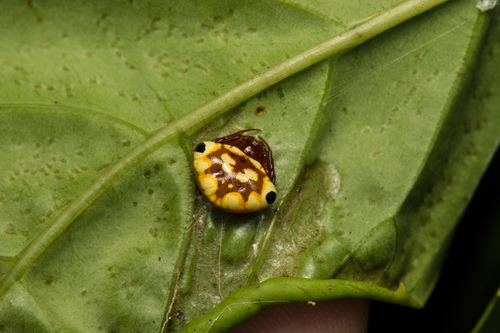
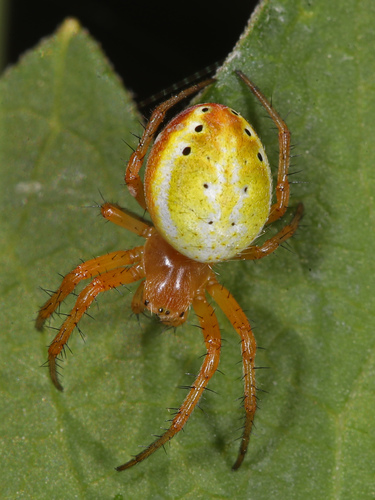
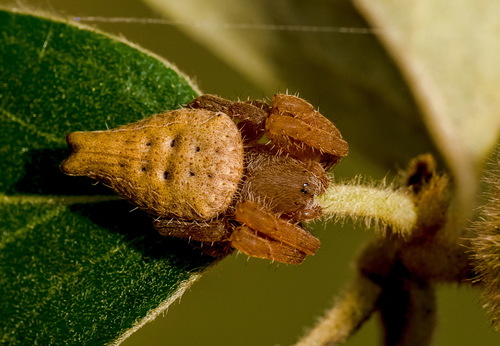
Cyrtophora exanthematica (Doleschall, 1859) gets its common name 'double-tailed tent spider' from the pair of blunt projections at the posterior end of its abdomen. In Australia, it is also known by other common names: dome spider, bowl spider, pan-web spider, and scoop-web spider. Like other species in the genus Cyrtophora, the upper side of the double-tailed tent spider's cephalothorax is flattened. The cephalothorax, the sides of the abdomen, and the legs are covered with white hairs. Its leg length order, from longest to shortest, is I, II, III, IV: the front first pair is the longest, the second pair is the next longest, the third pair is shorter than the second, and the fourth last pair is the shortest. Its eight eyes are roughly equal in size and arranged in two recurved rows. The species also has a characteristic pair of humps on the front side of the abdomen, which resemble 'shoulders' and give the abdomen a distinctive triangular shape. Eight prominent sigilla, small pit-like depressions, are arranged in two rows on the upper side of the abdomen. The abdomen is subrectangular with somewhat flat sides, has small tubercules at the front, is longer than it is wide, and tapers toward the rear. The underside of the abdomen is usually brown, with yellow book lungs. The spinnerets have a white rim. In females, the epigynum has a short triangular scape, or ovipositor, and the spermathecae (sperm receptacles) are globular. Double-tailed tent spiders vary considerably in color: they may be red, pink, orange, yellow, brown, grey, pale brown, or completely black. In some individuals, two wavy, sometimes 'beaded' chalk-white line patterns are clearly visible, running from the front of the abdomen, to the tip of the humps, and down to below the pair of 'tails'; in others, these lines are only faintly visible. The species is sexually dimorphic, with males generally far smaller than females. Adult females average around 10 mm (0.39 in) in length, excluding legs, and can reach up to 15 mm (0.59 in). Adult males average only 3.5 to 6 mm (0.14 to 0.24 in) in length, have an abdomen roughly the same size as their cephalothorax, and have prominent pedipalps. Double-tailed tent spiders closely resemble Cyrtophora parangexanthematica from the Philippines; this similarity is reflected in C. parangexanthematica's scientific name, which literally means 'like exanthematica'. Double-tailed tent spiders are widespread in tropical Asia and Australia. Their native range extends from Australia to southern Japan, and from the Philippines and Papua New Guinea west as far as India. They typically build permanent webs on the branches of trees or shrubs. Double-tailed tent spiders build their webs in tree or shrub branches, using surrounding leaves and twigs as a framework. Their webs have two distinct parts. The upper section is an irregular dense mass of random supporting webs, called a 'tangle web', which discourages prey from entering from the top of the web structure. At the bottom is a horizontally oriented, exceptionally finely-meshed orb web around 0.5 m (1.6 ft) in diameter. Like the webs of other tent-web spiders, this structure is somewhat tent-like, but unlike other tent-web spiders, the orb web of the double-tailed tent spider is most often shaped like a pan or a bowl. Unlike the webs of other orb-weavers, no part of this web is sticky. The spider stays in the middle of the lower orb web hanging upside down, but when threatened, it will run to the edge of the web and hide among vegetation and debris. The spider has a sanctuary at the edge of the web surrounded by dead leaves that it uses for camouflage. Males of the species can share the same web as a female. The webs are permanent, and over time they gather leaves and other debris. Double-tailed tent spiders clean their webs regularly, usually at night, though they keep some debris for camouflage. Webs are sometimes rebuilt when severely damaged. Double-tailed tent spiders mate during summer. After mating, the female lays her eggs in an ovoid silk egg sac inside her sanctuary, then stretches her body over the surface of the egg sac to guard it. This distinctive behavior makes the species easy to recognize. The mother does not feed or leave the sanctuary until the eggs hatch, which usually happens after two to three weeks. Only after hatching will she return to the center of the web and resume normal activities. Spiderlings remain in the mother's sanctuary for a few more weeks before leaving to live independently. Because their webs are relatively large, they are often infested with kleptoparasitic split-faced silver spiders (Argyrodes fissifrons). While dewdrop spiders (genus Argyrodes) can build their own webs, they prefer to live and even reproduce in the webs of other spiders, stealing prey from the host. They may stay permanently in one web or move between several nearby tent webs. The number of A. fissifrons living in a double-tailed tent spider web is directly proportional to the size of the web. The relationship can sometimes be commensal or even mutual, since A. fissifrons eat prey tangled in the webs that are too small for the larger double-tailed tent spiders. However, A. fissifrons often also take stored food or prey that the host is already consuming. Larger A. fissifrons are bolder, but they usually stay on the tangle web and keep out of the host's way. Double-tailed tent spiders generally tolerate their presence, though they sometimes push A. fissifrons away when they catch larger prey.