About Cyrtonyx montezumae (Vigors, 1830)
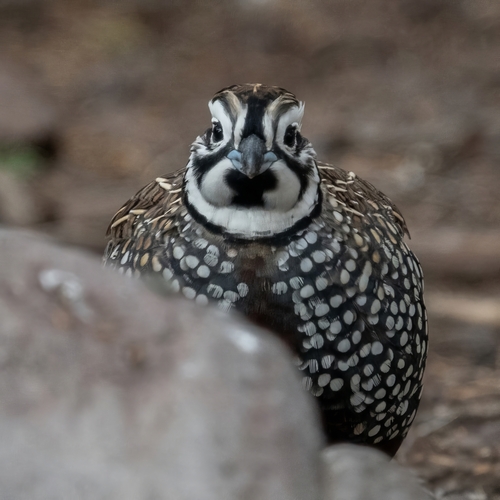
This species, scientifically named Cyrtonyx montezumae (Vigors, 1830), measures around 22 cm (8.75 in), making it one of the shortest quail species native to North America. Despite its short length, it weighs 180 g (6 oz), matching the weight of some somewhat taller Callipepla quails. Compared to other quails, it has a plumper body build and a shorter tail. For both sexes, the back and wing coverts are tan, marked with longitudinal light-buff streaks that follow the feather shafts, and circular or transversely oblong black spots arranged in bars. A crest on the nape creates a distinctly long front-to-back profile. The upper half of the bill is black, while the lower half is bluish-gray. Adult males have a striking, swirling black-and-white face pattern. A single tan plume lies flat over the crest. Males have blue-gray sides (which often appear black) marked with bold spots: northern individuals have entirely white spots, while southern individuals have white spots towards the front of the sides and chestnut spots towards the back. The center of the chest and belly is dark brown in northern birds, and lighter, tawnier brown in southern birds. Females show a faint version of the male’s face pattern. Their underparts are light brown, with a few fine black shaft streaks and additional fine lines. Juveniles resemble females, but their underparts are grayish, with white shaft streaks and black dots. Immature males develop the adult side patterning early, but do not grow their full adult face pattern until early winter. A distinctive unusual trait of this species is its long, sickle-shaped claws, which it uses for digging. This species ranges from Oaxaca north through the interior of Mexico, reaching the mountains of central and southeastern Arizona, central and southwestern New Mexico, and West Texas. It does not live in deserts or the Río Balsas valley. It has five subspecies split into two plumage types: northern and southern. These two types interbreed and blend in central Veracruz. Its preferred habitat is open woodland, most commonly oak woodland, but it also occupies pine-oak and juniper woodland that has grass standing at least 30 cm (1 ft) tall. It especially favors the slopes of hills and canyons. The species' total range is currently decreasing and becoming increasingly fragmented.