About Cyrtodactylus cattienensis Geissler, Nazarov, Orlov, Böhme, Phung, Nguyen & Ziegler, 2009
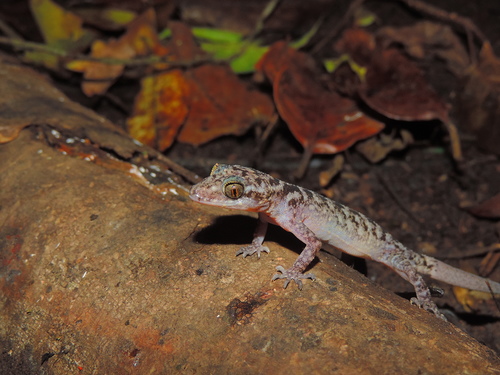
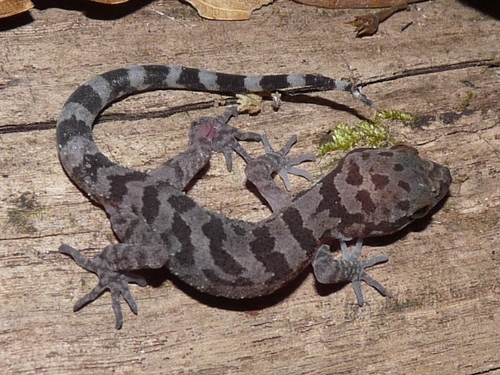
Cyrtodactylus cattienensis is a small species, with a maximum snout–vent length (SVL) of 69 mm (2.7 in). On average, males are smaller than females, with an average male SVL of 55 mm compared to an average female SVL of 61 mm. This species has a neck band that extends to the posterior margin of the eye. Its trunk, tail, and limbs have irregularly shaped bands: there are 4–6 light bands on the trunk and 4–12 white bands on the tail. It has 16–22 irregular longitudinal rows of dorsal tubercles. Lateral folds are weakly developed or entirely absent, and do not have enlarged tubercles. Males have 6–8 precloacal pores arranged in an angular continuous series, and a patch of enlarged precloacal scales is present in both sexes.
Cyrtodactylus cattienensis lives in lowland seasonal tropical forest. Most individuals were found on large leaves of scrub vegetation and young trees around 1 m above ground. A number of specimens were also found during the day, under volcanic rocks or beneath the bark of rotten trees.