About Cyptocephala antiguensis (Westwood, 1837)
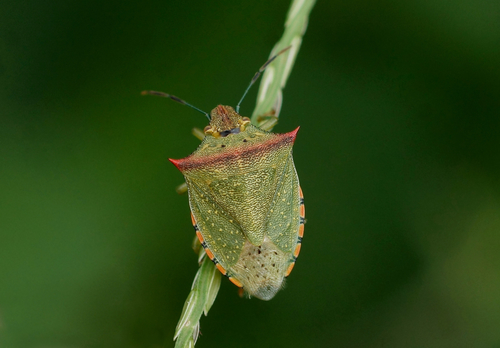
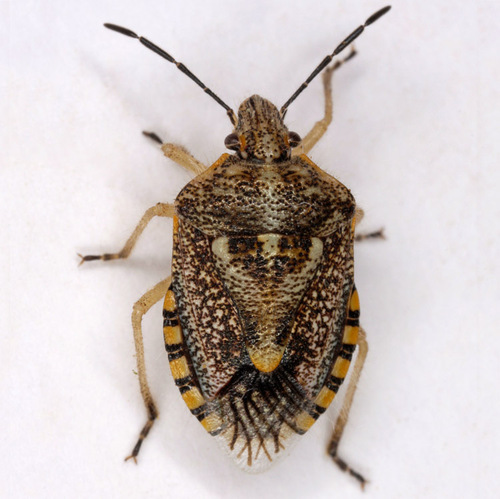
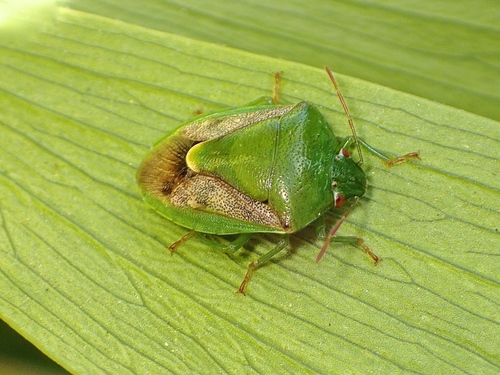
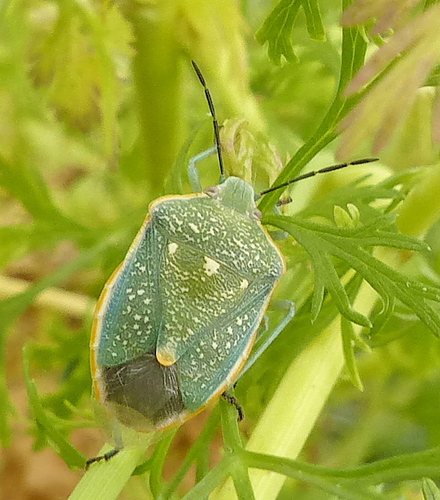
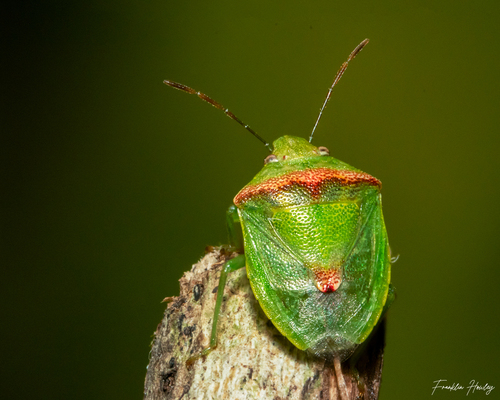
Cyptocephala antiguensis (Westwood, 1837) varies in body color, ranging from solid light tan to rich green, and often has ivory, reddish-brown, and black markings. These markings are most prominent as a multi-colored band across the back and a spot at the tip of the triangular scutellum. The sides of the head are parallel or nearly parallel between the area in front of the eyes and the smoothly rounded head tip. The head projections called juga do not extend past the central tylus. The edges of the pronotum, the area behind the head, are straight to slightly curved inward and are not raised. The triangular scutellum measures between 38 and 46% of its base width at a specific point. The body sides, called the pleura, are smooth with no raised areas. Excluding the wings, body length ranges from 5.5 to 7.8 mm. The base plates are slightly swollen, and their inner edges cannot be seen from the side. The parameres, which are male reproductive structures, cover a small tooth-like structure on each side of the genital area. The front lobe of each paramere varies in width, sometimes matching the width of the side lobe or being much wider than it. In females of this species, the slightly swollen base plates are unique within the Cyptocephala genus. Among males, only Cyptocephala antiguensis and Cyptocephala elegans have parameres that completely cover the small tooth-like structure or ridge on the sides of the genital area. Unlike C. elegans, C. antiguensis does not have raised pleural bands. This species is distributed in southern California, Arizona, Texas, and Florida in the United States. Its range also extends through Mexico, Central America, and the Caribbean, across northern South America, and reaches as far south as northern Peru in the Andes region. In the western portion of its range, which extends south to western Panama, the paramere lobes have noticeably uneven widths. In the eastern portion of its range, from Puerto Rico down through the Lesser Antilles and South America, the paramere lobes are more evenly sized. Despite this geographic pattern, the typical western form also occurs in Florida, Cuba, and Jamaica. Intermediate forms, which carry traits from both the western and eastern variants, are found in Florida, Cuba, and Hispaniola. It is unknown whether similar trait blending occurs in eastern Panama or nearby Colombia, but most of the few males studied from western Panama show a narrowed front lobe.