About Cypripedium parviflorum Salisb.
Cypripedium parviflorum Salisb. is an orchid species that grows 16 to 60 cm tall, with occasional reports of individuals reaching 80 cm in other regions. Its stem, bracts, and leaves are covered in soft hairs, and the flowering stem extends 10 cm above the leaves. Plants most often produce one flower, and rarely produce two. It grows from a jointed rhizome that bears few to many slender roots up to 4 cm long.
Its leaves are ovate-lanceolate, attached to the stem, and pleated. Blooming plants have 4 to 6 leaves, ranging in size from 9 × 4 cm to 14 × 5 cm. The underside of leaves is covered in fine hairs, with only a few hairs present on the upper surface. An ovate-lanceolate floral bract grows at the base of the ovary, measuring 7 × 2 cm.
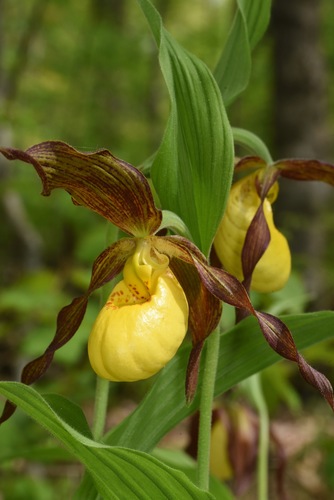
The flower has a bright yellow pouch-shaped lip, with greenish to reddish sepals and petals; the full flower measures up to 10 cm high and 10 cm wide. Sepals are yellowish green with reddish stripes that become dots near the pouch, with fine hairs on the back and edges. The dorsal sepal is ovate-lanceolate and slightly concave, measuring 4 × 2.2 cm. The fused synsepal is elliptic, slightly concave, with a slight notch at the tip, and measures 3.2 × 1.4 cm.
Petals are linear with pointed tips, yellowish green with reddish stripes that become dots near the pouch, and measure 5.5 cm long by 0.7 cm wide. Fine hairs grow along the well-defined central ridge on the back of the petal, with a few hairs on the inner third of the petal near the pouch. The lip, or pouch, is bright yellow and obovoid (pouch- or slipper-shaped), measuring 3.2 cm wide by 4.0 cm high. Its opening is 1.2 × 2.0 cm with an incurved margin, and it has red dotted stripes along the veins, plus faint reddish dots on the inside and back of the pouch.
The column is light green with red dots at its base, and is 1.5 cm high. It holds two fertile anthers, one on each side. The staminode is yellow with red dots, arrowhead-shaped and folded into a V shape, and the pollinia are yellow sticky masses. The fruit is an ellipsoidal, hair-covered capsule 2.2 to 3 cm long and 0.6 to 1.3 cm in diameter.
This species ranges from Newfoundland to British Columbia, Canada, south to Georgia, Arizona, and Washington in the United States, and is also found in Europe. In western North America, it extends from Newfoundland to Alaska, south to Oregon. In eastern North America along the Atlantic Coast, it occurs in every U.S. state except Florida, and extends across the continent to Louisiana and eastern Texas. In New Mexico, it is found in Catron, Colfax, Grant, Los Alamos, Otero, San Miguel, San Juan, and Santa Fe Counties. In Arizona, it occurs in Apache, Graham, and Greenlee Counties.
Cypripedium parviflorum is primarily an upland plant that prefers subacidic to neutral soils. It is found mainly in mesic to dry-mesic upland forests, woodlands with deep humus or leaf litter layers, and shaded boggy habitats. It also grows in hill prairies, and occasionally occurs in wetlands with organic, well-drained, sandy soils. In fir, pine, and aspen forests between 1,800 and 2,900 m (6,000 to 9,500 feet), it prefers moderate shade to nearly full sun. It may also be found in mountain meadows, on timbered slopes, and on dripping seeps on steep to moderately sloped canyon walls.