About Cypripedium calceolus L.
Scientific name: Cypripedium calceolus L.
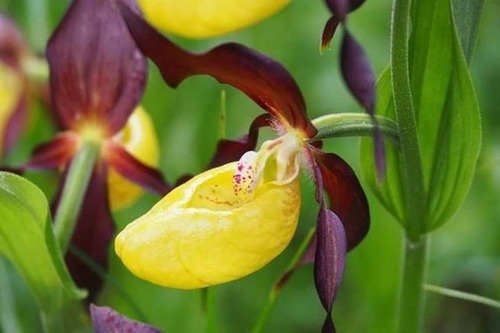
This is the largest-flowered orchid species in Europe, growing up to 60 cm (24 in) tall, with flowers reaching 9 cm (3.5 in) wide. Before flowering, it can be told apart from other orchids by the large size and width of its ovate leaves; leaves can grow as large as 18 cm (7.1 in) long and 9 cm (3.5 in) wide, and like other orchids, it has parallel leaf venation. Each shoot produces up to four leaves and a small number of flowers, most commonly one or two. The flowers have long, often twisted petals that range in colour from red-brown to black, and are very rarely green. They also feature a yellow, slipper-shaped labellum with red dots visible inside. This species is a long-lived perennial that spreads via horizontal underground stems called rhizomes. When not in flower, it can be confused with Allium ursinum, Convallaria majalis, or several orchid species in the genus Epipactis. It closely resembles other Cypripedium orchid species native to the United States. Recorded chromosome counts for this species are 2n=20 and 2n=22.
This species has a widespread distribution stretching from Europe east through Asia, from Spain to the Pacific coast. It occurs in almost every European country, plus Russia (including European Russia, Siberia, and the Russian Far East), northeastern China (Heilongjiang, Jilin, Liaoning, Nei Mongol), Mongolia, Korea, and Rebun Island in Japan. It typically grows in open woodlands on moist calcareous soils. In continental Europe, it also grows in decomposed humus within semi-shaded limestone woodlands. Across most of Europe, its population has declined significantly, so it is legally protected in several countries. It grows at elevations up to 2,100 metres (6,900 ft).
Cypripedium calceolus is frequently found growing alongside stands of hazel trees. It is pollinated by multiple different insect species, including at least seven miner bee species in the genera Andrena and Colletes, as well as at least two furrow bee species in the genus Lasioglossum. Slugs and snails frequently herbivorize this species, and plants are highly susceptible to this damage. This orchid primarily associates with mycorrhizal fungi from the family Tulasnellaceae, and specific mycorrhizal relationships are critical for orchids to access nutrients from soil. Other fungi that have been suggested as potential mycorrhizal partners include Alternaria sp., Ceratorhiza sp., Chaetomium sp., Cylindrocarpon sp., Epicoccum purpureum, Epulorhiza sp., Moniliopsis sp., Mycelium radicis atrovirens, Phoma sp. and Rhizoctonia subtilis.