About Cypripedium acaule Aiton
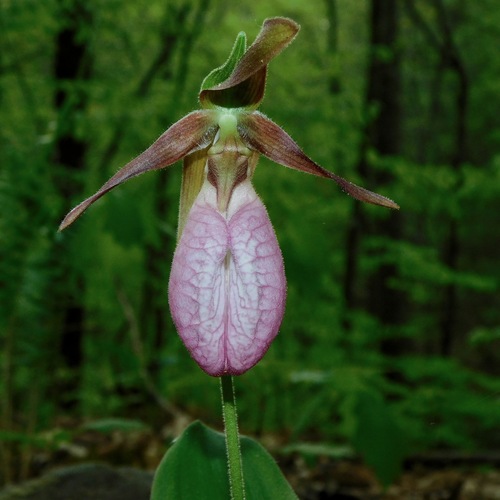
Cypripedium acaule Aiton is a perennial orchid that grows slowly, reaching a maximum height of 0.4 m (1 ft 4 in). Each season, it produces just one solitary flower on its peduncle, emerging from between two large basal leaves located close to the ground. The leaves are simple, elliptical, opposite in arrangement, and plicate. Unlike most other Cypripedium species, the pouch of C. acaule has an opening slit that runs down the front of the labellum, instead of a round opening. A long, pubescent stalk sprouts from between the two leaves to carry the single flower. The plant's sepals and petals are typically colored yellowish-brown to maroon, while the large flower pouch is most often some shade of pink, though it can range from white to nearly magenta. Pollination occurs when bees are attracted into the flower's slit opening, but bees eventually stop visiting the plant because it offers them no benefits. This species is distributed across the eastern third of the United States, particularly in the Great Lakes region, and the Northeast including New Hampshire and Maine, extending south along the Appalachian Mountains to Alabama. It is widespread across Canada, found in every province except British Columbia, and also occurs in the Northwest Territories and St. Pierre & Miquelon. Within its range, it grows across a wide variety of environments, from coastal plains and pine barrens to mountaintops. It requires highly acidic soil, tolerates a range of shade and moisture conditions, but prefers at least partial shade and well-drained slopes. It is most commonly found in pine forests, where it can grow in large colonies, though it also grows in deciduous woods. It was long thought that C. acaule required a fungal association to grow, and could not be artificially cultivated without this association. Improved general understanding of orchids has since shown that this association is only required for germinating orchid seeds, and is not needed once plants develop their true leaves. C. acaule is listed as endangered in Illinois and Tennessee, vulnerable in New York, and unusual in Georgia. Commercial availability of C. acaule has increased thanks to seed germination labs, but it is still less commonly available than other Cypripedium species and hybrids. This is primarily because it requires extra care when grown in sites that are not naturally suited for in-ground cultivation. This plant grows in soils with a pH below 5, most often between 4 and 4.5. At this high acidity, soil fungus is suppressed, allowing C. acaule to thrive. There is evidence that the plant is partially myco-heterotrophic, parasitizing fungus that attempts to invade its roots. In soils with a pH above 5, soil microbes become too abundant for C. acaule to manage, and the plants rot. Seedlings germinated in a sterile environment can grow and thrive at a pH much higher than 5, but must be grown at a pH below 5 once removed from sterile conditions. For artificial cultivation, container culture is required, and the growing medium must be naturally acidic. All other soil additives must be free of any calcium that could buffer pH above 5. High quality peat moss or pine duff work well as growing medium, and pH-neutral perlite can be added to improve porosity. Tap water is unsuitable for cultivation due to the risk of calcium bicarbonate. Rainwater, or distilled water mixed with 2 ounces (57 g) of vinegar per gallon, will reliably maintain high acidity in the growing medium. Plants should be given bright dappled shade or morning sun. During winter, pots should be sunk into the ground or stored in a cold frame for insulation. When these conditions are met, C. acaule can thrive indefinitely, but it always requires much more maintenance than other Cypripedium species and hybrids that tolerate a wider pH range.