About Cyprinodon macularius Baird & Girard, 1853
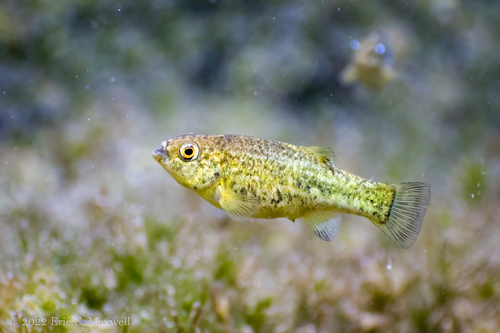
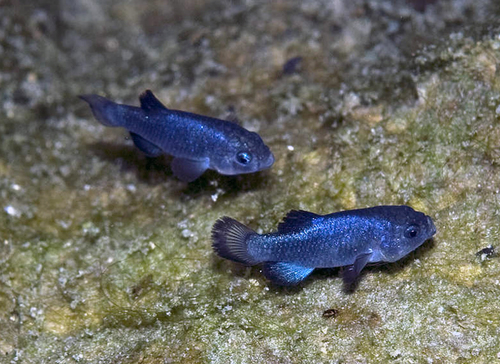
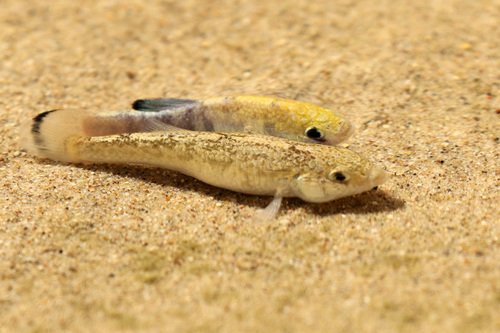
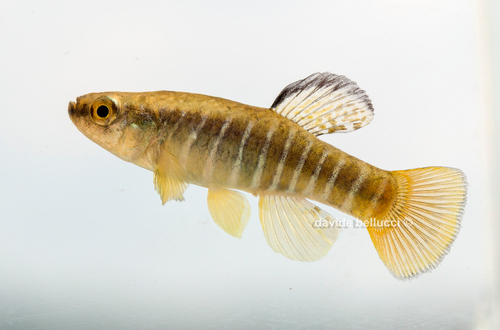
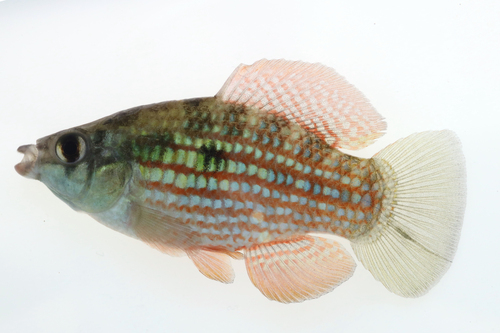
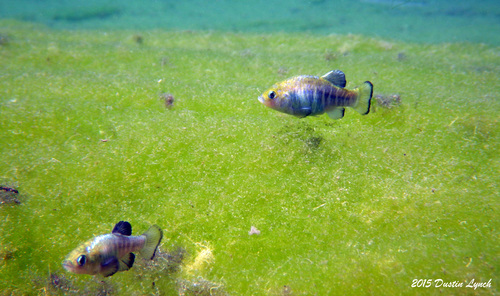
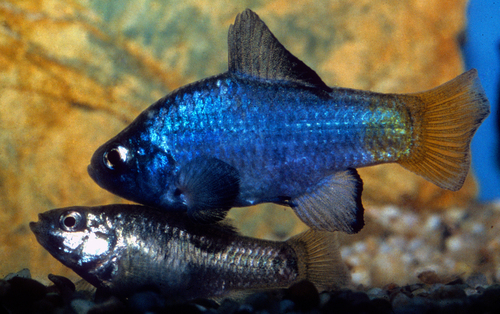
Cyprinodon macularius Baird & Girard, 1853, commonly called the desert pupfish, is a small fish that is typically less than 7.62 cm (3 in) long. Males are larger than females and generally have more vivid markings, especially during breeding seasons. Females and juveniles typically have tan or olive backs and silvery sides with narrow, dark vertical bars on their lateral sides. These bars are often interrupted, creating the appearance of a disjunct lateral band. During mating season, the dorsal portion of males' heads and sides turn bright blue, and their caudal fin and posterior caudal peduncle become yellow or orange. The desert pupfish has a smoothly rounded dorsal profile, a thickened, laterally compressed body, a protruding mouth, and tricuspid teeth. The desert pupfish inhabits shallow waters of desert springs, small streams, and marshes located below 1,524 m (5,000 ft) in elevation. It can tolerate higher salinities, higher water temperatures, and lower oxygen content than most fish, allowing it to occupy habitats that are inhospitable to invasive fish. Desert pupfish typically prefer clear waters with rooted or unattached aquatic plants, restricted surface flow, or sand-silt substrates, and thrive in habitats with little vegetation other than mats of benthic algae. Historically, the desert pupfish ranged across the lower Colorado River in Arizona and California, the Gulf of Mexico, and the Colorado River Delta in Sonora and Baja California. Specifically, it occurred in the Salton Sink basin in California; the Gila River basin in Arizona and Sonora, including the Gila, Santa Cruz, San Pedro, and Salt Rivers; the Rio Sonoyta in Arizona and Sonora; Puerto Peñasco, Sonora; and the Laguna Salada basin in Baja California. A large population of desert pupfish is protected at the Cibola National Wildlife Refuge. However, due to both habitat destruction and species reclassification, the desert pupfish has a much smaller current distribution than previously recorded. As of 2010, naturally occurring populations in the United States are restricted to two tributaries, various shoreline pools, and irrigation drains of the Salton Sea in California. In Mexico, the species is scattered across the Colorado River Delta and the Laguna Salada basin. In total, there are 11 known extant wild populations of desert pupfish across the United States and Mexico. Successful reintroduction attempts have established 16 transplanted populations in Arizona, along with 46 captive or refuge populations in Arizona, California, and Mexico. The desert pupfish's breeding season generally runs from early spring into winter, occurring when water temperatures rise above roughly 20 °C. When food is abundant and temperatures are suitable, desert pupfish may reach sexual maturity as early as six weeks of age. Though some individuals may breed during their first summer, most do not reproduce until their second year. The species displays two breeding behaviors: territorial arena-breeding (high aggression), which is the most common and occurs in large habitats with high primary productivity, limited breeding substrates, and high population density; and consort-pair breeding (low aggression), which occurs in habitats with low primary productivity, abundant breeding substrates, and low population density. During the breeding season, male pupfish establish, actively patrol, and defend individual territories that are typically less than 1 meter deep and 1 to 2 square meters in area. Territory size varies based on individual fish size, density of other male pupfish, and water temperature, and territories are associated with small substrate structures or irregularities. Adult females swim in loose schools and forage without drawing attention. When a female is ready to spawn, she leaves the school to enter the territory of a preferred male, at which point mating begins. Temperature plays a significant role in egg production. The highest rates of egg production occur at constant temperatures between 24–32 °C, and at fluctuating temperature ranges of 32–28 °C and 36–28 °C. Temperature also affects egg quality, with an inverse relationship between temperature and yolk diameter. The salinity of the environment where eggs are laid also impacts reproductive performance: the optimal reproductive performance occurs at 10% salinity, and performance decreases when salinity is either above or below 10%.