About Cyprinella lutrensis (Baird & Girard, 1853)
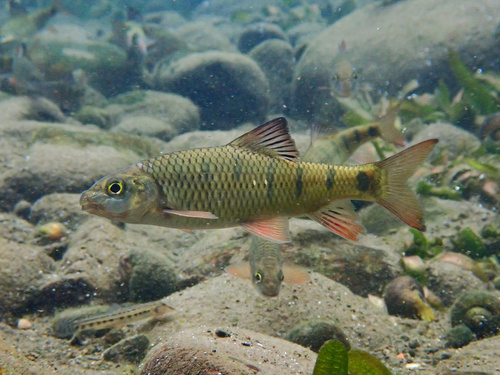
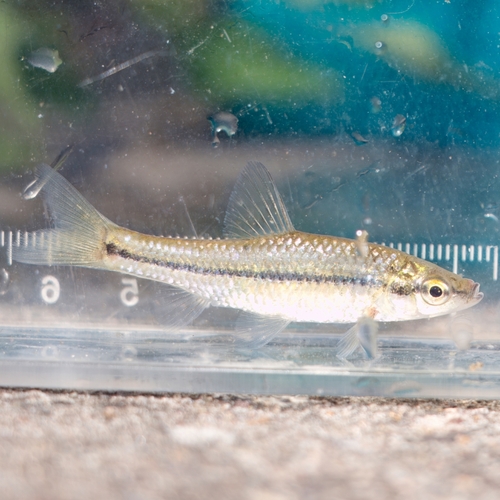
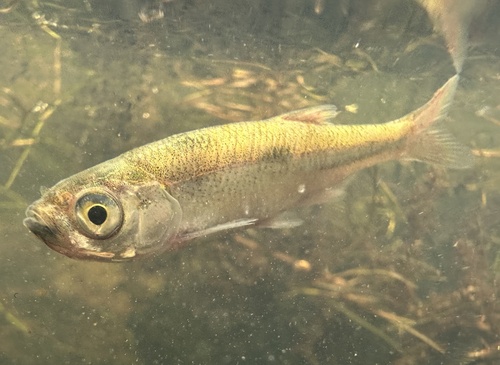
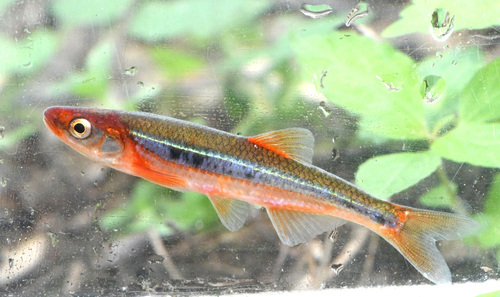
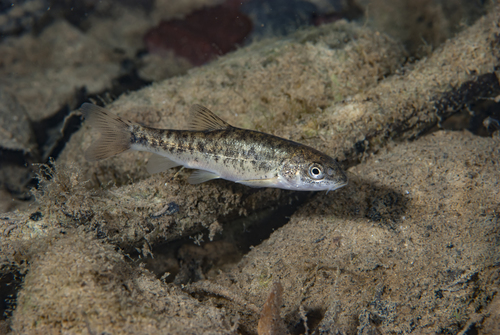
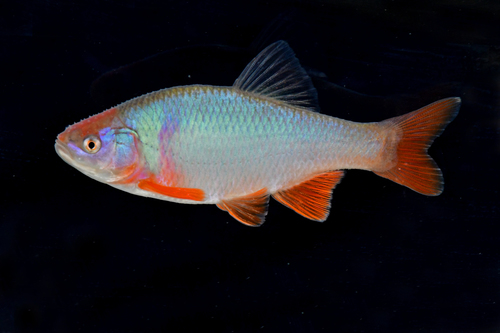
Cyprinella lutrensis, commonly known as the red shiner or red-horse minnow, is a species of freshwater ray-finned fish belonging to the family Leuciscidae, which includes shiners, daces, and minnows. Individuals of this species have deep, laterally compressed bodies and can reach a maximum length of around 3 inches, or 7.6 centimeters. For most of the year, both males and females have silver sides and whitish abdomens. When in breeding condition, however, males develop iridescent pink-purple-blue sides along with a red crown and red fins; only the dorsal fin stays dark. Red shiners can live up to three years. They are omnivorous, feeding on aquatic and terrestrial invertebrates, and algae. They have also been recorded eating the eggs and larvae of native fish in areas where they have been introduced. Naturally, red shiners occupy a wide range of aquatic habitats, including backwaters, creek mouths, riffles, pools, and streams with sand and silt substrates. They tolerate areas with frequent high turbidity and siltation, but typically avoid highly acidic waters. As habitat generalists, red shiners are adapted to thrive in a wide range of environmental conditions that are unsuitable for most other fish species. These conditions include habitats degraded by human disturbance, poor water quality such as that found in polluted waterways, natural physiochemical extremes, and seasonally intermittent flows. The native range of the red shiner covers the Mississippi River basin, extending from southern Wisconsin and eastern Indiana west to South Dakota and Wyoming, and south to Louisiana. It has also been introduced as an non-native species to Arizona, Alabama, California, Colorado, Illinois, Georgia, Nebraska, North Carolina, South Carolina, Wyoming, Massachusetts, Utah, Virginia, Nevada, and New Mexico. While the species as a whole is widespread and common, the subspecies Cyprinella lutrensis blairi from Maravillas Creek in Texas went extinct in the late 1950s, driven to extinction by competition from the invasive plains killifish. The spawning season for red shiners typically runs from mid-April through September. Like other members of the genus Cyprinella, they spawn in crevices, but they also broadcast eggs that attach to rocks or vegetation. Females can release up to 16 batches of eggs per day, with up to 71 eggs per batch. The average total clutch size per reproductive season is 585 eggs, and red shiners may produce between 5 and 19 clutches in a single breeding season. Red shiners can produce viable hybrid offspring when they cross with closely related species, including the blue shiner and the blacktail shiner.