About Cypraea tigris Linnaeus, 1758
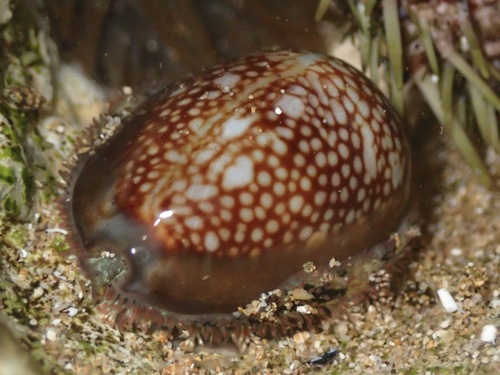
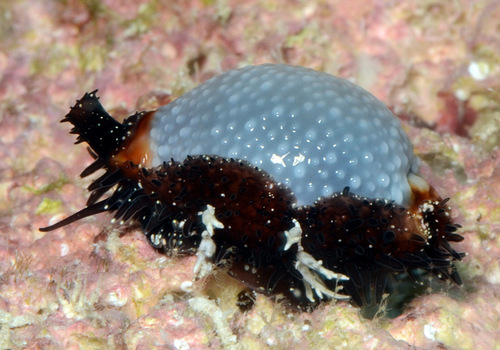
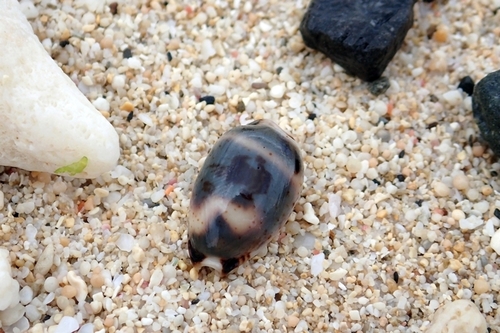
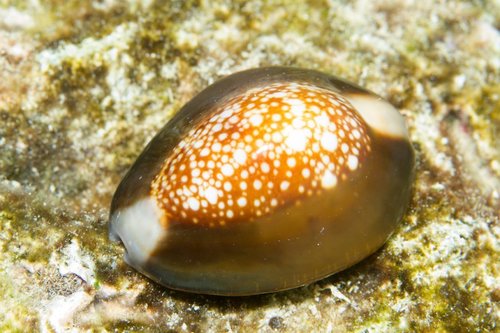
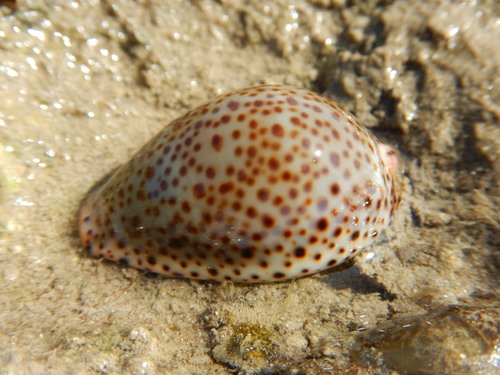
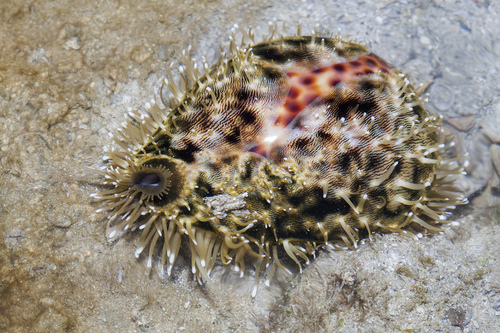
Cypraea tigris, commonly known as the tiger cowrie, has a roughly egg-shaped, dextral shell that is large and heavy for a cowry. The shell can grow up to 15 cm (6 in) in length. Its glossy upper (dorsal) surface is colored white, pale bluish-white, or buff, and is densely covered with dark brown or blackish, nearly circular spots. Like many other snails in the Cypraea genus, the shell’s surface is notably shiny, as if it has been deliberately polished. Sometimes, a blurred red line runs along the dorsal midline of the entire shell length. The lower margins of the shell are rounded, meaning there is no sharp dividing edge between the shell’s upper and lower surfaces, unlike in some other cowry species. The ventral (lower) side of the shell is white or whitish, and the shell aperture is lined with tooth-like serrations. As with almost all cypraeids, this species has two lateral mantle extensions that can extend to fully cover the shell, meeting at the dorsal midline. The mantle can also withdraw back into the shell opening when the animal is threatened. On the exterior surface of the mantle, there are numerous pin-like projections with white tips. The tiger cowrie lives on the ocean floor across the Indo-Pacific region, ranging from the eastern coast of Africa to the waters of Micronesia, Polynesia, the Coral Sea, and the area around the Philippines. Along the Australian coast, it occurs from northern New South Wales to northern Western Australia, as well as at Lord Howe Island; it is also found along the entire east coast of Africa including Madagascar. It inhabits depths between 10 and 40 metres (35–130 ft), and is most often associated with live coral colonies such as table-forming Acropora, found either directly on reefs or on the sandy sea bottom adjacent to reefs. Once a common species, it is now far less abundant due to commercial shell collecting and habitat destruction from activities such as dynamite fishing, particularly in shallower areas. Tiger cowries are carnivorous: adult individuals feed on coral and various invertebrates, while juveniles eat algae. This species is classified as endangered in Singapore. Even though the tiger cowrie does not naturally occur in the Mediterranean Sea, shells of this species and its relative the panther cowrie (Cypraea pantherina) have been excavated at the ancient Roman city of Pompeii, near Naples, Italy. At Pompeii, these shells may have been used as a type of ornament, though it is also possible they were part of an early natural history collection. Natural history was a topic of significant interest in that era, demonstrated by Pliny the Elder, who wrote extensively about seashells in his work Natural History and died while investigating the eruption of Mount Vesuvius that destroyed Pompeii. Today, the shells of Cypraea tigris remain popular among shell collectors, and are still used as decorative objects in modern times. In Japan, the shell is thought to help ease childbirth, and some women there hold a tiger cowrie shell during labor. In relatively recent history, large cowry shells like this species’ were used in Europe as frames to stretch sock heels during darning, serving as an alternative to a darning egg. The cowry shell’s smooth surface lets the darning needle be moved under the cloth more easily than when using a wooden darning mushroom.