About Cyphoma signatum Pilsbry & McGinty, 1939
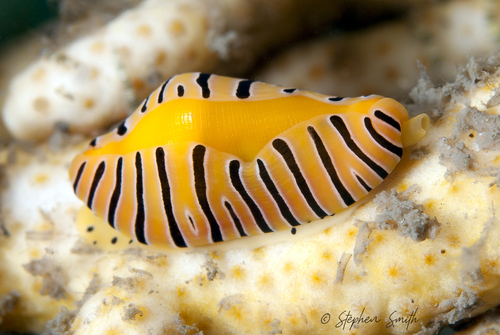
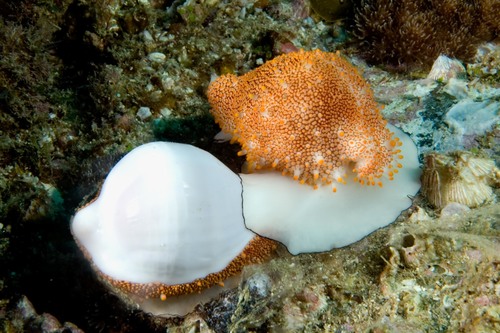
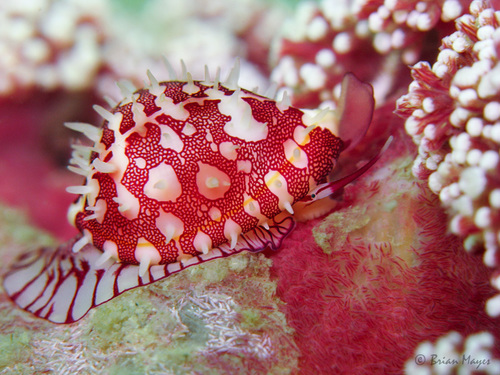
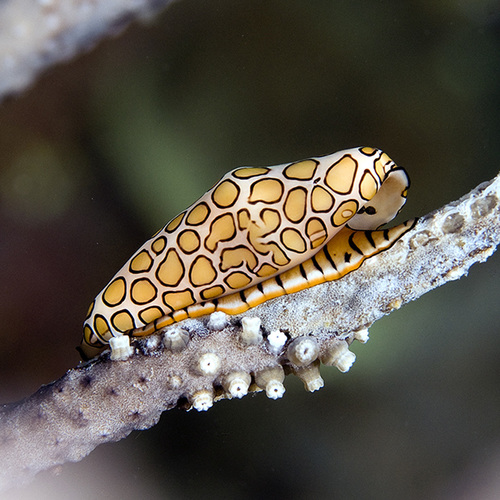
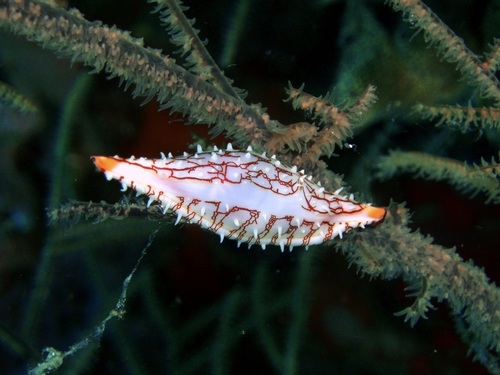
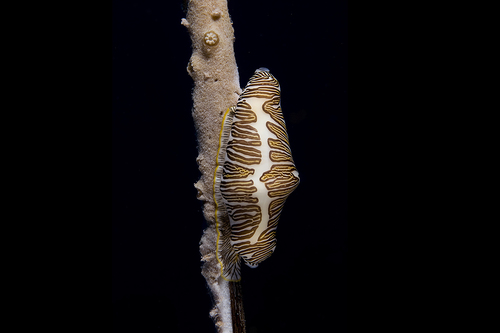
When Cyphoma signatum Pilsbry & McGinty, 1939 is alive, the snail displays a bright orange-yellow color with black markings. These colors do not belong to the shell; they come from the live mantle tissue that normally covers the shell. The mantle flaps can be retracted to expose the shell, but this usually only occurs when the animal is attacked. On average, the shells of this species reach a length of 25–35 mm (0.98–1.38 in), with a minimum recorded size of 18 mm (0.71 in) and a maximum recorded shell length of 45 mm (1.8 in). The shell is usually elongated in shape, and its dorsum features a thick transverse ridge. The surface of the dorsum is smooth and shiny, and may be white or orange. It has no markings at all except for a longitudinal white or cream band. The base and interior of the shell is white or pinkish, with a wide aperture.
This species is the most common of several species in the genus Cyphoma. It lives in the tropical waters of the western Atlantic Ocean, ranging from North Carolina to the northern coast of Brazil. Its distribution includes waters off Bermuda, within the Caribbean Sea and the Gulf of Mexico, and off the Lesser Antilles. One source records its depth range from a minimum of 0.3 m to a maximum of 90 m; another source records its depth range from a minimum at the surface to a maximum of 29 m.
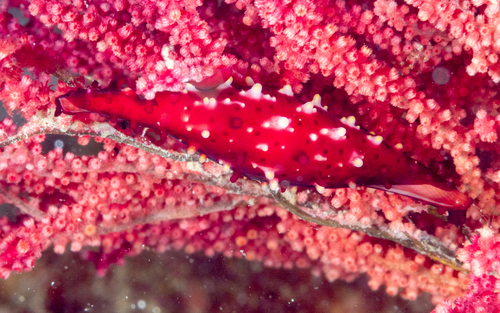
This snail, commonly called the flamingo tongue snail, feeds by browsing on the living tissues of the soft corals that it lives on. Common prey species include Briareum spp., Gorgonia spp., Plexaura spp., and Plexaurella spp. Adult females attach eggs to coral that they have recently fed upon. The larvae hatch after roughly 10 days; they are planktonic and eventually settle onto other gorgonian corals. Juveniles tend to stay on the underside of coral branches, while adults are much more visible and mobile. An adult scrapes polyps off the coral with its radula, leaving an easily visible feeding scar on the coral. However, the corals can regrow the polyps, so predation by this snail is generally not lethal.