About Cyphia bulbosa (L.) P.J.Bergius
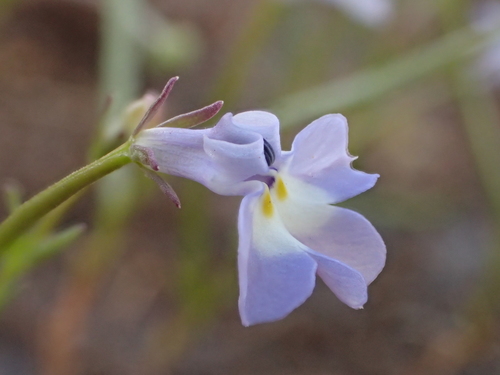
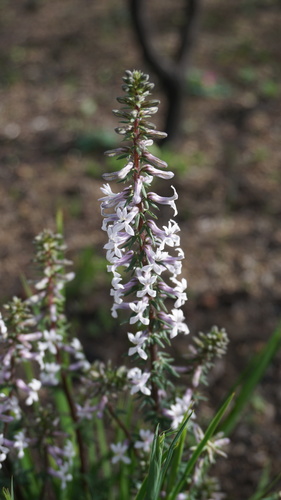
Cyphia bulbosa (L.) P.J.Bergius is a bulbous geophyte that reaches a mature height of 12 to 30 cm (4.7 to 11.8 in). Most of its leaves grow in a basal cluster, and they gradually reduce to form bracts along the upper stem. The leaves are deeply dissected, with a palmatisect or palmatifid shape, and have a paler coloration on their undersides. Flowering occurs between August and November. Blooms grow in racemes and range in color from white to mauve. Each individual flower measures 8 to 13 mm (0.31 to 0.51 in) in length, and is encircled by a toothed or lobed bract. Like other species in the genus Cyphia, the style of this plant has a fluid-filled stigmatic cavity instead of a free stigma. It produces two bearded anthers on stamens that are 6 mm (0.24 in) long. Its triangular calyx lobes are separated by rounded interspaces. The seeds are thick and oval-shaped, with narrow wings along their edges. This species is endemic to South Africa. It grows on sandy and stony flats and slopes in the region stretching between the Cedarberg Mountains and the Cape Peninsula, and it is a common plant in Cape Town.