About Cyperus vaginatus R.Br.
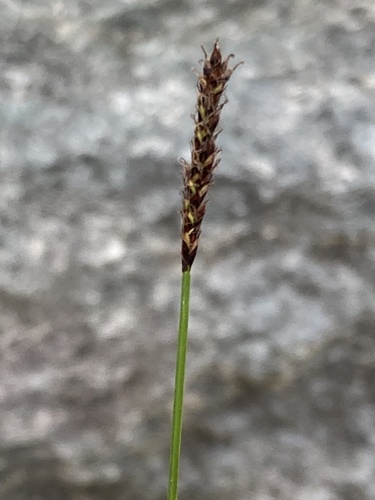
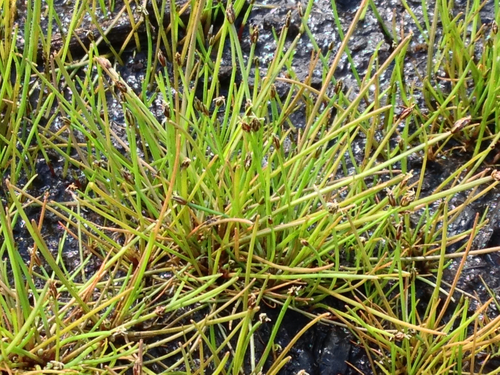
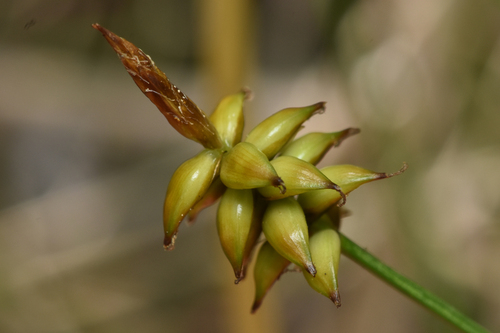
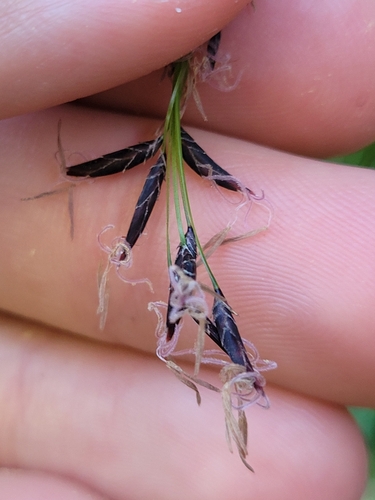
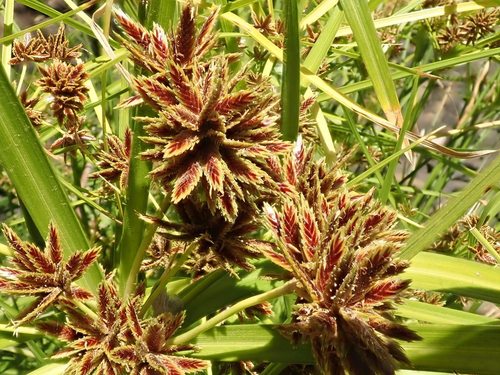
Cyperus vaginatus R.Br. is a rhizomatous, perennial, grass-like sedge that grows in a tufted habit. It typically reaches a height of 0.3 to 2 metres (1.0 to 6.6 ft), and blooms between November and February, producing green-brown flowers. Its rigid terete culms grow to approximately 1 metre (3.3 ft) in height, with a diameter of around 3 millimetres (0.12 in); its leaves consist only of sheaths. The inflorescence is either simple or compound, with four to twelve primary branches that grow up to approximately 6 centimetres (2.4 in) long, and are usually shorter. The flattened spikelets occur in clusters of four to fifteen, each measuring 5 to 18 mm (0.20 to 0.71 in) long and 2 to 2.8 mm (0.08 to 0.11 in) wide. After flowering, it forms a grey-brown, trigonous nut with an obovoid to ellipsoid shape, which is around 0.6 to 0.8 mm (0.024 to 0.031 in) long and approximately 0.5 mm (0.020 in) in diameter. This species is found in subtropical regions, with its northern range extending into tropical areas. In Western Australia, it grows along creeks and streams in the Kimberley, Pilbara, Gascoyne, Mid West, and Goldfields-Esperance regions, where it inhabits sandy-clay alluvium, most often around limestone. It also occurs in northwestern and southeastern South Australia, Victoria, Queensland, the Northern Territory, and New South Wales. When cultivated, it grows best in full sun to part shade in well-drained soils, and may require summer watering. In Victoria, the species was historically found in the Grampians and around Swan Hill, but no specimens have been collected there since 1913, and it is now possibly extinct in these areas. Cyperus vaginatus is harvested from the wild as a source of fibre. Fibre from the outer parts of its stems is traditionally used by Indigenous Australians to make nets and cordage, and the species is known to attract butterflies.