About Cyperus lecontei Torr. ex Steud.
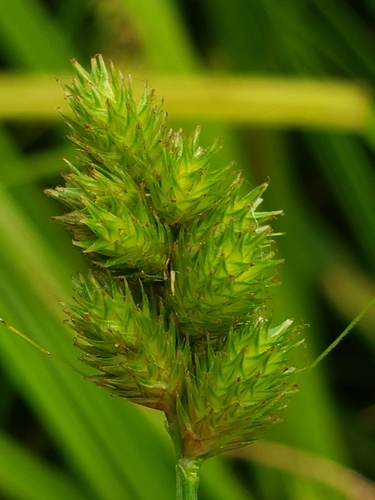
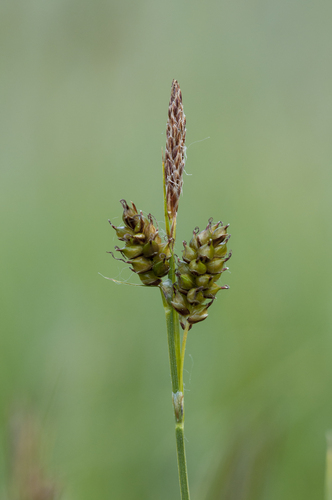
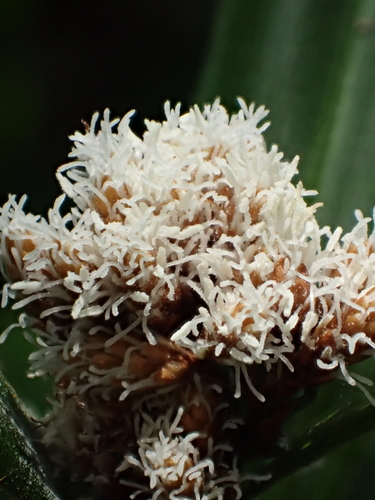
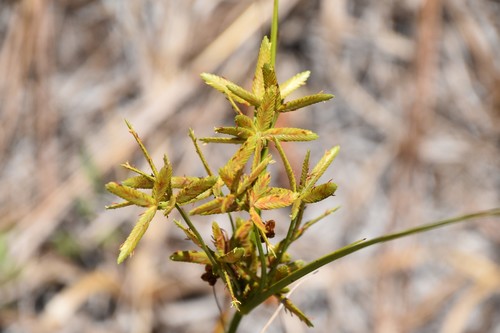
Cyperus lecontei Torr. ex Steud. is a perennial herbaceous sedge that survives through a creeping rhizome. Its inflorescence produces clusters of spikelets, each containing numerous florets. Every floret is covered by a scale, which is a type of bract found in sedges and grasses. In 1836, American botanist John Torrey described Cyperus lecontei as a variety of Cyperus dentatus, listing the following characteristics: stems two feet long, leafy at the base, with leaves shorter than the stem; the inflorescence is a compound umbel with 10–12 primary rays; six leaf-like bracts grow at the base of the inflorescence; a cluster of 3–5 compressed spikelets ends each secondary ray of the inflorescence; each spikelet holds 14–24 florets covered by scales with obtuse tips (angles greater than 90 degrees). Torrey noted that compared to Cyperus dentatus, Cyperus lecontei has longer, more numerous primary rays, and floral scales with obtuse tips rather than acute tips. A more detailed description of this species was published in Flora of North America in 2002. Cyperus lecontei has stems 10–50 cm (4–20 in) long. It is leafy at the base, with leaves 10–40 cm (4–16 in) long and 2–5 mm wide. Its inflorescence is a compound umbel with 5–12 primary rays, each growing up to 12 cm (5 in) long. Three to five leaf-like bracts sit at the base of the inflorescence. A cluster of 2–4 compressed spikelets terminates each secondary ray of the inflorescence. Each spikelet contains 20–60 florets covered by straw-colored or reddish green scales. Each floret is bisexual, with three anthers and a single style bearing three branched stigmas. The anthers and stigmas emerge from the axil of the floral scale, and no perianth is present. The fruit is an achene less than 1 mm long. Cyperus lecontei is native to the southeastern United States. Its range extends from Arkansas and Louisiana eastward along the Gulf Coastal Plain, across the Florida panhandle, to the Atlantic Coastal Plain of the Carolinas. It is a rare species in all U.S. states in its range except Florida, where it is common. This perennial herbaceous flowering plant grows and flowers from July to September.