About Cyperus diandrus Torr.
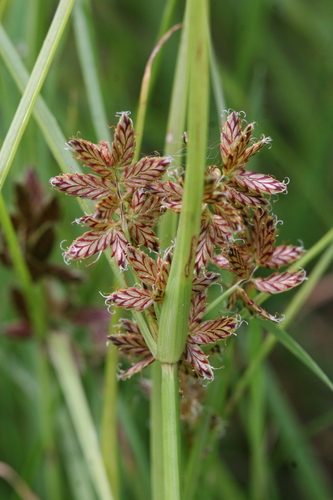
Cyperus diandrus Torr. is an annual sedge with fibrous roots. It grows in a tufted (cespitose) habit, producing multiple stems at its base. Stems rarely grow taller than 25 cm (9.8 inches). The inflorescence sits at the top of the stem and holds clusters of spikelets, each containing numerous florets. Two to three leaf-like bracts grow at the base of the inflorescence. The main spikelet cluster at the stem apex is stalkless, and is accompanied by 0 to 4 additional clusters growing on stalks up to 6 cm long. Each cluster holds 6 to 12 flattened spikelets, and the terminal spikelet is usually erect. Each spikelet contains 8 to 28 florets, and each floret is covered by a scale, a specialized bract found in sedges and grasses. Each floret has two anthers, occasionally three, and a branched style with two stigmas. A perianth is absent. The anthers and stigmas emerge from the axil of the floral scale. The fruit produced by this species is an achene. Cyperus diandrus is sometimes confused with Cyperus bipartitus. Both species have pigmented floral scales that range in color from reddish-brown to purplish-brown, but the two can be distinguished by the pigment pattern on the scale surface. Cyperus diandrus has a thin pigmented band along the scale margin, leaving a noticeable pale area on the face of the scale. Cyperus bipartitus has much heavier pigmentation, with no pale area present on the scale. Occasionally, Cyperus diandrus will have entirely pale greenish-white scales, making it resemble Cyperus flavescens. Because scale color can be misleading, examining the styles helps with identification: Cyperus diandrus has persistent styles that project 2–4 mm beyond the tip of the scale, while Cyperus bipartitus has deciduous styles that project less than 2 mm. The relatively long styles of Cyperus diandrus give its spikelets a woolly appearance. Because Cyperus diandrus is often confused with other species, published range maps for this species should be interpreted carefully. For example, in 1960, many Illinois herbarium specimens labeled as Cyperus diandrus were found to be misidentified; after re-examination, the species was confirmed to occur in only eight Illinois counties. This species is native to northeastern North America, where its range extends from Nova Scotia south to Virginia, and west as far as Nebraska. It has been introduced to Germany, and also to the U.S. state of Washington. In 2002, the Flora of North America recorded Cyperus diandrus in the following regions: in Canada, it occurs in New Brunswick, Nova Scotia, Ontario, and Quebec; in the United States, it occurs in Connecticut, Delaware, Illinois, Indiana, Iowa, Maine, Maryland, Massachusetts, Michigan, Minnesota, Missouri, Nebraska, New Hampshire, New Jersey, New York, Pennsylvania, Rhode Island, Vermont, and Virginia. Within the United States, it is especially common in New England, New York, New Jersey, and the Midwestern United States. Across its entire range, Cyperus diandrus grows on shorelines in sandy, peaty, and slightly brackish habitats, and it is usually not found in disturbed areas. Its growing and flowering season runs from July to October.