About Cyperus dentatus Torr.
Cyperus dentatus Torr. is a perennial herbaceous sedge that survives via a creeping rhizome, with small tubers growing at the ends of the rootstalk’s branches. Its inflorescence holds clusters of spikelets, each of which contains numerous florets. Every floret is covered by a scale, which is a specialized type of bract found in sedges and grasses. In addition to spikelets, plants of this species often produce vegetative propagules called bulblets. These bulblets differ in appearance from spikelets, so plants bearing bulblets are distinctive and easy to identify. In 1859, American naturalist Henry David Thoreau referred to this species as bulblet sedge, and described it as "a plant and color looking toward autumn".
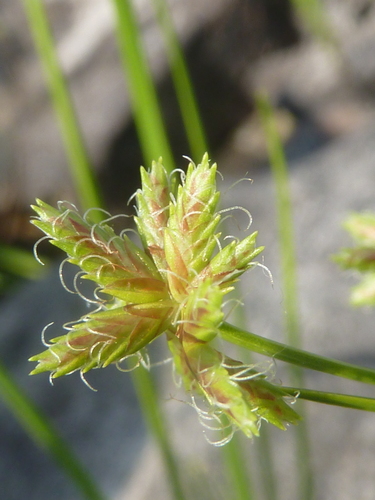
The first formal description of Cyperus dentatus was published in 1817. American botanist John Torrey also published an English description of the species in 1823, and published another description in 1836. Torrey called this "this beautiful species", and provided the following original description: Stem about one foot long, leafy at the base, leaves shorter than the stem. Inflorescence is a compound umbel with 4–7 primary rays of unequal length. Three leaf-like bracts grow at the base of the inflorescence. A cluster of 3–5 compressed spikelets terminates each secondary ray of the inflorescence. Each spikelet holds 6–30 florets covered by scales with acute tips measuring less than 90 degrees.
A more detailed description was published in the Flora of North America in 2002. According to this description, Cyperus dentatus has stems 8–50 cm (3–20 in) long. It is leafy at the base, with leaves 10–40 cm (4–16 in) long and 2–5 mm wide. The inflorescence is a compound umbel with 4–10 primary rays of unequal length, where each ray can grow up to 8 cm (3 in) long. There are 3–5 leaf-like bracts at the base of the inflorescence, with at least one bract longer than the primary rays of the umbel. A cluster of 2–6 compressed spikelets terminates each secondary ray of the inflorescence. Each spikelet has 3–20(–50) florets covered by reddish brown scales with prominent tips. Each floret is bisexual, with three anthers and a single style that has three branched stigmas. The anthers and stigmas emerge from the axil of the floral scale, and no perianth is present. The fruit is an achene that grows up to 1 mm long. The chromosome count for this species is 2n = 34.
Cyperus dentatus resembles Cyperus lecontei, a species that occurs in the southeastern United States. In the southeastern U.S. states of Georgia, South Carolina, and North Carolina, plant specimens of Cyperus lecontei have often been misidentified as Cyperus dentatus, which has caused confusion around the actual distribution of Cyperus dentatus.
Cyperus dentatus is native to southeastern Canada and the eastern United States. In Canada, it is found in New Brunswick, Nova Scotia, Ontario, and Quebec. In the United States, it has been recorded in Connecticut, Delaware, District of Columbia, Indiana, Maine, Maryland, Massachusetts, New Hampshire, New Jersey, New York, Pennsylvania, Rhode Island, Tennessee, Vermont, and Virginia. Plant specimens have been collected as far south as the coastal plain of Alabama, but some authorities do not recognize the species as naturalized in this location. Reports of Cyperus dentatus from Georgia, South Carolina, and North Carolina are likely based on misidentified Cyperus lecontei, not true Cyperus dentatus. Cyperus dentatus grows best on sandy or gravelly shorelines and coastlines. It is commonly found throughout the Atlantic coastal pine barrens, an ecoregion characterized by sandy, nutrient-poor soil. One of the original specimens of Cyperus dentatus was collected in the New Jersey Pine Barrens in the early 19th century. In Virginia, this species is restricted to acidic sinkhole ponds in the Shenandoah Valley west of the Blue Ridge in Augusta County.
Cyperus dentatus is a flowering plant with an active growing season from July to October. It flowers in July and August, and produces fruit from August to October. It can reproduce asexually via bulblets, tubers, and rhizomes. Bulblets are often found on plants that also produce fruit, but it is common to find plants that only produce bulblets and no fruit, especially in September when bulblet production reaches its peak. In Quebec and Vermont, where the species is uncommon, populations that cannot produce viable seed instead produce bulblets that can be successfully germinated in laboratory conditions.