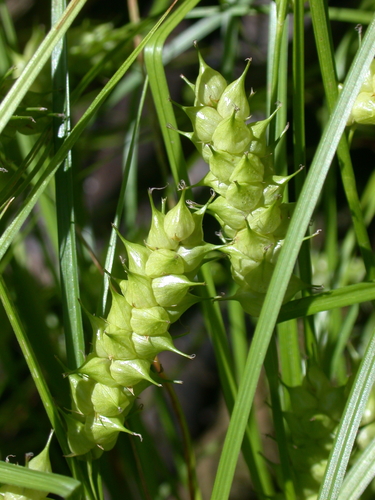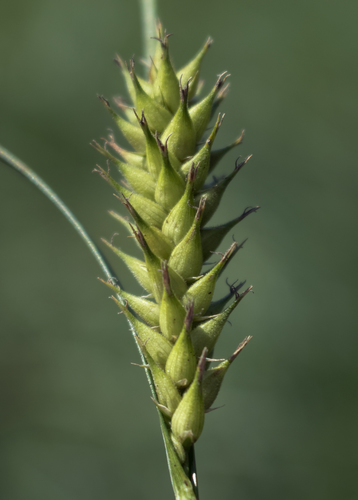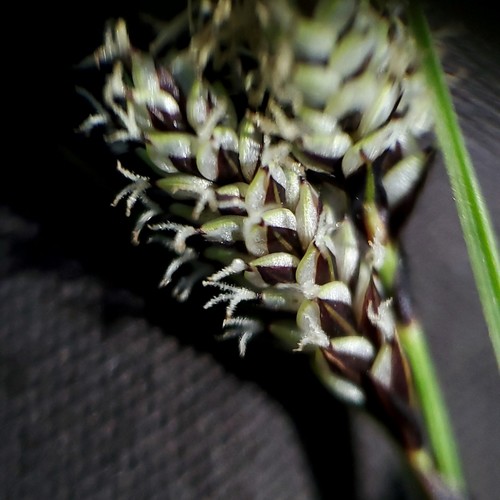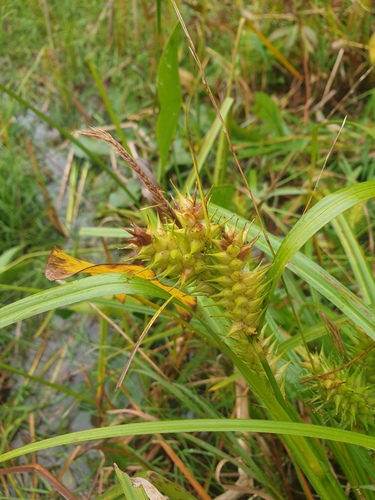
About Cyperus compressus L.
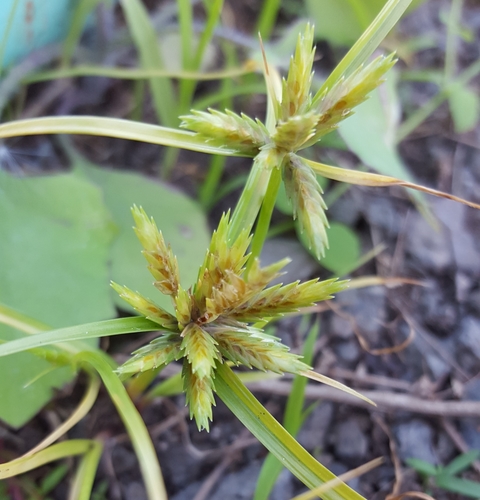
Cyperus compressus L. is an annual tufted sedge that typically grows to a height of 0.1 to 0.75 metres (0.3 to 2.5 ft). It blooms between May and December, producing green-yellow-brown flowers. This erect, glabrous plant has numerous fine roots, and slender or rigidulous trigonous stems that are 0.5 to 2.0 millimetres (0.020 to 0.079 in) thick. The base of the plant is covered by red-purple, loose, open leaf sheaths. Its leaves are much shorter than the stems, are greyish-green in color, narrowly linear in shape, and measure 1.5 to 4.0 mm (0.06 to 0.16 in) wide. The inflorescence is made up of umbellate spikes, with three to four rays that can grow up to 8 centimetres (3 in) in length. After flowering, it forms a dark brown to black trigonous broad-obovoid nut, which is about 1.5 mm (0.059 in) long and around 1 mm (0.039 in) in diameter. This species has a wide distribution across tropical and subtropical regions. It occurs throughout much of Asia, particularly in India, Malaysia, Pakistan, and the Philippines; across much of Africa from Egypt to Zimbabwe; in the Americas, it is found in the southern United States, Honduras, Costa Rica, Suriname, and northern South America; and it also grows in Fiji and New Guinea. It is a pantropical species that mostly grows in moist locations including irrigated fields, ditches, stream beds, pond margins, and lawns. It can grow in many soil types, most commonly sandy, alluvial, or clay soils. It has been introduced to many areas outside its native range; in Australia, it is found in damp areas of the Kimberley region of Western Australia, as well as in Queensland, New South Wales, and the Northern Territory.