About Cyperus bipartitus Torr.
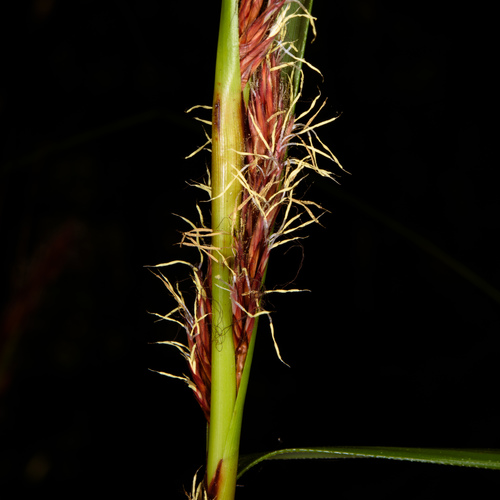
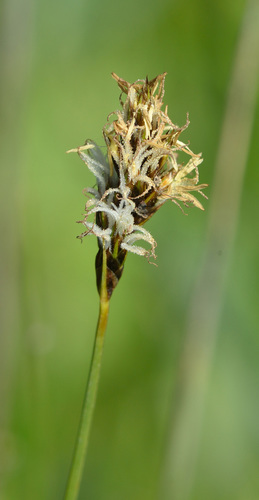
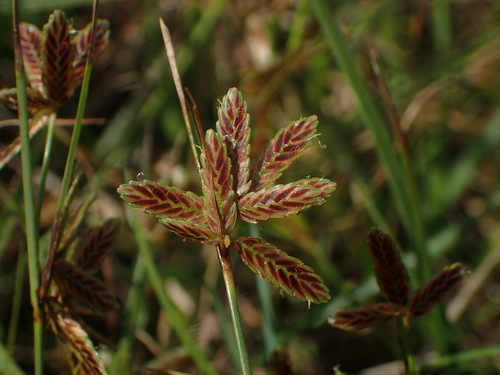
Cyperus bipartitus Torr. is an annual sedge with fibrous roots. It produces multiple stems growing from the plant's base, and any single stem rarely grows taller than 25 cm (9.8 in). The inflorescence that develops above the stem holds clusters of spikelets, each containing numerous florets. At the base of the inflorescence, there are 2 to 3 leaf-like bracts. The main cluster of spikelets at the top of the stem is stalkless, and it is accompanied by 0 to 4 additional clusters that grow on stalks up to 3 cm long. Each cluster holds 3 to 10 flattened spikelets, and the terminal spikelet is usually held erect. Each spikelet contains 10 to 26 florets, and each floret is covered by a scale, a specialized type of bract found in sedges and grasses. Every floret is bisexual: it has 2 to 3 anthers and one style with two branched stigmas. The anthers and stigmas emerge from the axil of the floral scale, and no perianth is present. The fruit this plant produces is an achene: a black disc roughly one millimeter wide. Cyperus bipartitus is sometimes confused with Cyperus diandrus. Both species have pigmented floral scales that range in color from reddish-brown to purplish-brown. The two species can be told apart by the pigmentation pattern of their scales, though occasionally the scales of either species may be entirely pale greenish-white. Cyperus diandrus has conspicuous, persistent styles, while the styles of Cyperus bipartitus are shorter and less conspicuous. This species is native to the Americas, ranging from southeastern Canada down to northern Argentina. It grows in wet environments including lakes, sandbars, and ditches, at elevations up to 1,500 metres (4,900 ft). North of Mexico, Cyperus bipartitus is most common in the Great Lakes region. It is relatively uncommon across the southeastern United States, and it is essentially absent from the region stretching east of Louisiana along the Gulf Coastal Plain, across the Florida panhandle, to the Atlantic Coastal Plain of South Carolina. The type specimens of both Cyperus bipartitus Torr. and Cyperus rivularis Kunth were collected from this missing range region, which explains why these two names have remained largely problematic for botanical research. Even with this issue, at least one of these two names has been consistently used since 1836. Cyperus bipartitus is a flowering plant with a growing and flowering season that runs from July to October.