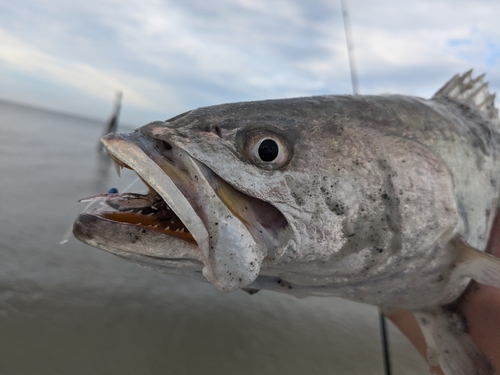
About Cynoscion nebulosus (Cuvier, 1830)
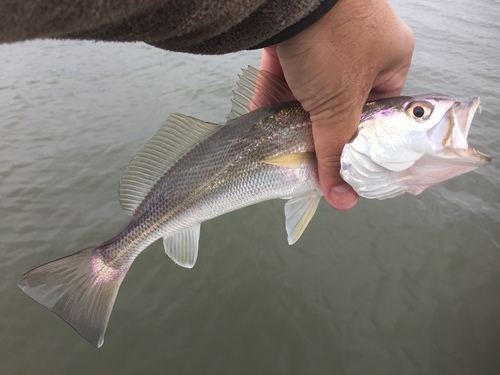
Cynoscion nebulosus (Cuvier, 1830) has the common name spotted seatrout, which is endorsed by the American Fisheries Society. It has many other common names, including speckled trout, speck, speckles, spec, truite gris (Louisiana French), trucha de mar (Mexican Spanish), spotted weakfish, spotted seateague, southern seateague, salmon, salmon trout, simon trout, winter trout, seatrout, Nosferatu fish, and black trout. Particularly large individuals of this fish are nicknamed gator trout. Spotted seatrout have prominent canine teeth. Like other fish in the family Sciaenidae, it has an elongated, soft dorsal fin that bears scales; this soft dorsal fin is separated from the spinous dorsal fin by a deep notch. It usually has two anal spines, and its lateral line extends all the way to the tip of the caudal fin. Distinct spots are scattered across its back, and these spots also appear on the dorsal and caudal fins. Unlike some other members of the Sciaenidae family, spotted seatrout do not have any chin barbels. In stained water, the fish's base body color may take on a golden hue. Its shape and coloration are reminiscent of a brown trout. This fish is closely related to the weakfish, Cynoscion regalis. The average weight of an adult spotted seatrout is 0.5–1.0 kg (1.1–2.2 lb), but fish up to 2.5 kg (5.5 lb) are fairly common in most of its range. Fish weighing 3.5–4.5 kg (7.7–9.9 lb) are rare, and the all-tackle world record for the species is 7.9 kg (17 lb 7 oz). Spotted seatrout inhabit the upper part of the water column, and are most numerous along the coasts of the southeastern United States, including the states of Texas, Louisiana, Alabama, Mississippi, Georgia, and Florida. They are also common along the coasts of North Carolina, South Carolina, and Virginia. Estuarine coasts are their primary settlement areas. They are uncommonly sighted north of Delaware Bay and along the coast of Cape Cod, Massachusetts, and are most abundant across the mid-Atlantic and southeastern regions of the United States. Speckled trout (another common name for the species) prefer water temperatures between 59 °F and 86 °F, and are typically found in waters with salinities between 5 and 35 ppt. Like all members of the drum family (Sciaenidae), mature male spotted seatrout produce a "drumming" sound to attract females during the spawning season. The species has a long spawning season that runs from spring through summer. Larval spotted seatrout reach 5–7 mm in length around two weeks after hatching, and grow to 170–200 mm within approximately seven months. It takes between one and two years for spotted seatrout to reach 300 mm (about 12 inches) in length, and between two and three years to reach 400 mm (about 16 inches). The maximum estimated age of caught spotted seatrout is 12 years old, though this is very rare; fish aged four or five years old are the oldest regularly caught. By the end of their first year of life, spotted seatrout are about 250 mm long, and roughly half of them are mature enough to reproduce. They spawn in shallow, grassy areas of estuaries. As spotted seatrout increase in length, they gain weight, but the relationship between weight and length is not linear. The relationship between total length (measured in millimeters) and weight (measured in grams) can be expressed by the equation W = cL^b, where b is almost always close to 3.0 for all fish species, and c is a constant that differs between species. The values of c and b are calculated by fitting this equation to measured weight-length data. For spotted seatrout, the weight-length relationship varies with both season and gender. Jenkins reported the following different relationships for male and female spotted seatrout in fall and spring: for fall males, W = 0.00000534L^3.093; for spring males, W = 0.000011535L^2.989; for fall females, W = 0.000006252L^3.066; for spring females, W = 0.000007834L^3.035. Only the relationship for male spotted seatrout in spring appears noticeably different from the other relationships when plotted on a graph. Small spotted seatrout eat large quantities of shrimp and other crustaceans. As they grow larger, their diet shifts to include more fish, and larger spotted seatrout target larger fish prey. Studies conducted in Texas and Mississippi show that very large spotted seatrout strongly prefer to feed on mullet; a large spotted seatrout will seek out the largest mullet it can eat and attempt to swallow it. Often, the mullet prey is half to two-thirds as large as the predatory spotted seatrout.