About Cynoscion arenarius Ginsburg, 1930
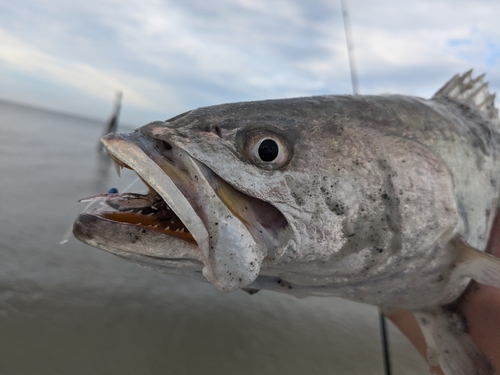
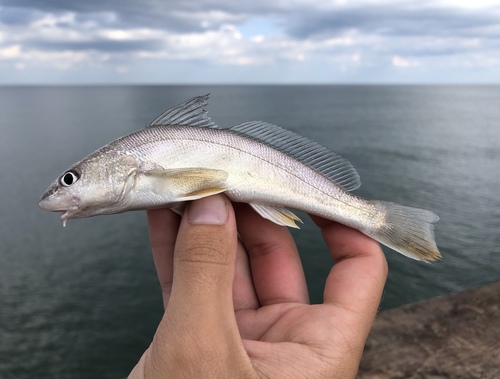
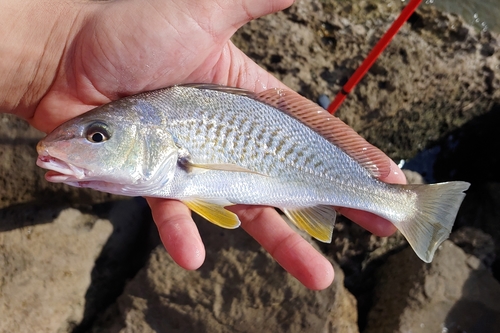
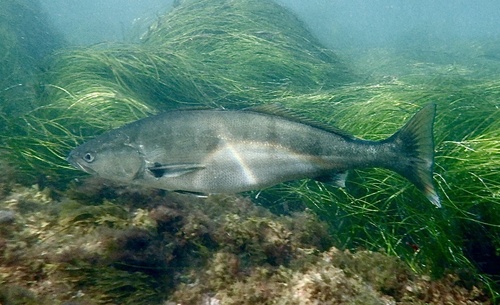
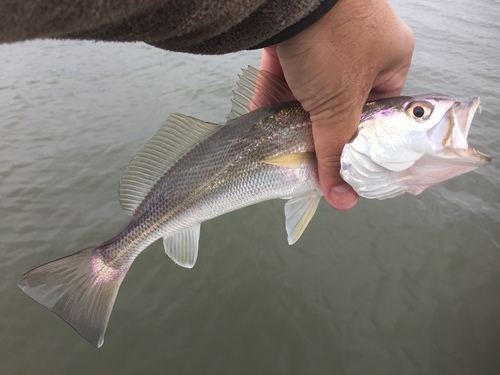
Cynoscion arenarius Ginsburg, 1930, has an elongated, compressed body. Its upper body is silvery gray, fading to silvery on the lower body. The anal and pelvic fins range from pale to yellowish, while the caudal fin and the soft-rayed section of the dorsal fin bear indistinct spots. The axil of the pectoral fins and the inside of the operculum are dark. Teeth are arranged in multiple rows, with 2 large canines at the front of the upper jaw; the lower jaw holds a row of widely spaced larger teeth that increase in size toward the back of the mouth. There are no barbels or pores on the chin, but the snout has 2 marginal pores. The dorsal fin is notched, with 9 or 10 spines in the section before the notch, and one spine plus 25 to 29 soft rays in the section after the notch. The anal fin has 2 spines and 9 or 10 soft rays. This species has a maximum published total length of 63.5 cm (25.0 in), with 35 cm (14 in) being the more common typical size, and a maximum published weight of 2.8 kg (6.2 lb). Cynoscion arenarius is distributed in the western Atlantic Ocean, ranging from Florida into the Gulf of Mexico, reaching as far south as the Bay of Campeche in Mexico, and also occurs in Belize. It is a demersal fish that lives in shallow coastal waters, including the surf zone and estuaries, over sandy substrate, at depths down to 177 m (581 ft).