About Cynopterus brachyotis (Müller, 1838)
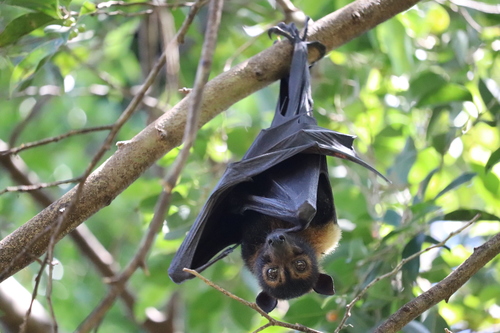
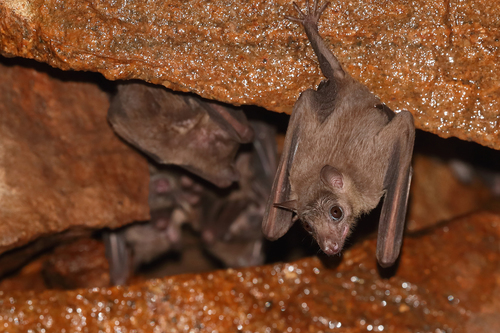
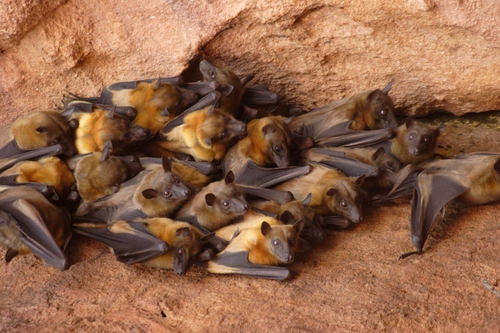
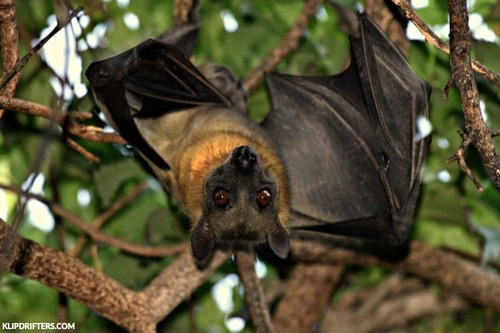
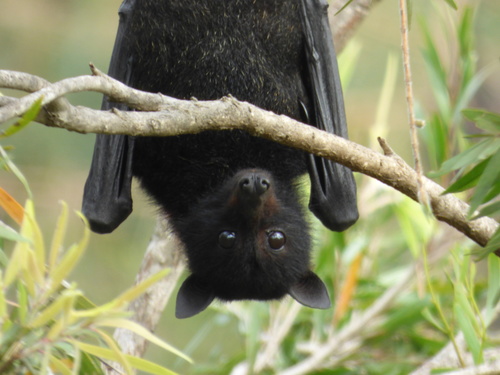
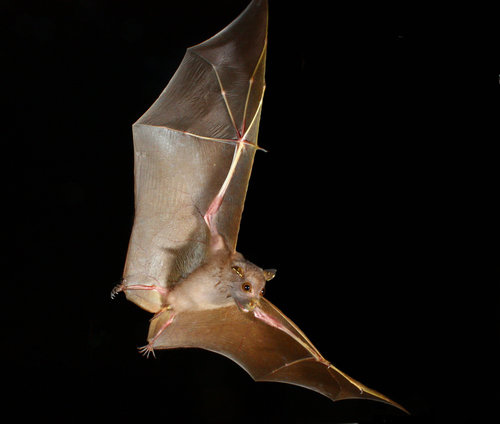
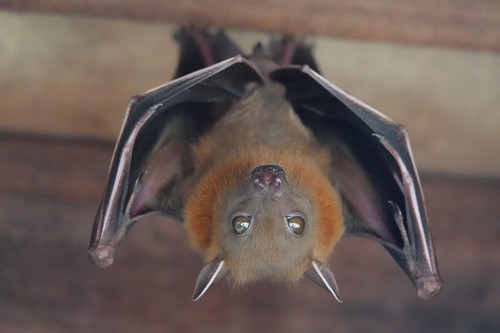
Cynopterus brachyotis, the lesser short-nosed fruit bat, is generally brown to yellowish brown with a brighter collar. Adult males have dark orange collars, while adult females have yellowish collars; some immature bats have an indistinct collar. The edges of the ears and the wing bones are usually white. This species has two pairs of lower incisors, a fox-like face, and large dark eyes. Head and body length ranges from 7–8 cm (2.8–3.1 in), forearm length is 6–7 cm (2.4–2.8 in), tail length is 0.8–1.0 cm (0.31–0.39 in), and ear length is 1.4–1.6 cm (0.55–0.63 in). There are nine recognized subspecies of the lesser short-nosed fruit bat. Corbet and Hill listed 19 alternate scientific names for C. brachyotis, which include: Pachysoma brachyotis, P. duvaucelii, P. brevicaudatum, P. luzoniense, C. grandidieri, C. marginatus var. scherzeri, C. marginatus var. ceylonensis, C. marginatus var. philippensis, C. marginatus var. cuminggii, C. marginatus var. andamanensis, C. brachyoma, C. montanoi, C. minutus, C. minor, C. babi, C. archipelagus and C. nusatenggara. Kitchener and Maharadatunkamsi considered luzoniensis and minutus to be separate species, while Hill and Thonglongya transferred angulatus to C. sphinx. The lifespan of the lesser short-nosed fruit bat is approximately 20 to 30 years. The type specimens of the lesser short-nosed fruit bat were collected from the Dewei River in Borneo on September 12, 1836, and at Naga Cave near Jammut on the Teweh River, Borneo. This species is widely distributed in Sri Lanka, southwest and northeast India, Bangladesh, Andaman and Nicobar Islands, southern China, southern Burma, Indochina, Thailand, the Malay Peninsula, Sumatra, Java, Bali, Sulawesi, the Philippines, and the Lesser Sunda Islands. It ranges from sea level to 1,600 metres (5,200 ft) in altitude. The nominate subspecies, C. b. brachyotis, is distributed in Borneo, Lombok, Peninsular Malaysia, the Philippines and Sulawesi. C. b. altitudinis is confined to the highlands of Peninsular Malaysia, from the Cameron Highlands to Gunung Bunga Buah. C. b. brachysoma is found on the Andaman Islands; C. b. cylonensis is found in Sri Lanka; C. b. concolor is found in Enggano; C. b. hoffetti is found in Vietnam; C. b. insularum is found on the Kangean Islands; C. b. javanicus is found on Java; and C. b. minutus is found on Nias. The mating system of lesser short-nosed fruit bats is polygynous. In most Philippine populations, females give birth twice a year, and pregnant females have been found in almost every month. Gestation lasts approximately 3.5 to 4 months. Mothers nurse their young with milk for about six to eight weeks. Males take around one year to reach sexual maturity, while most females become pregnant at approximately six to eight months of age. Medway observed that breeding is non-seasonal in Peninsular Malaysia, where females produce a single young and carry it during the early stage of its life. Breeding is also non-seasonal in Thailand, though most pregnancies occur from March to June, with peaks in January and September. Lactation aligns with the peak of the rainy season and the annual fruiting season. Both sexes participate in caring for the young. Males play an active role in lactation and feeding the young, and have mammary glands that are the same size as those of females, exceeding 8% of their overall body mass.