About Cynops pyrrhogaster (Boie, 1826)
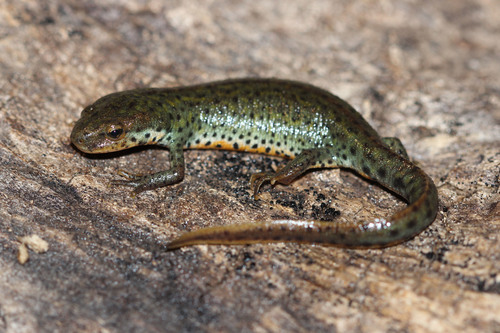
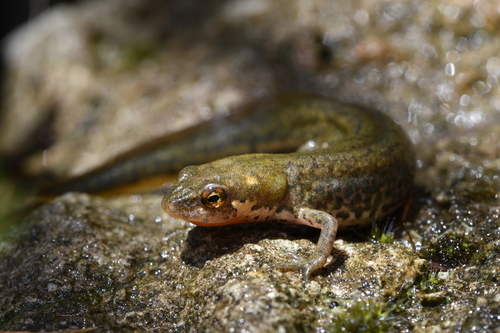
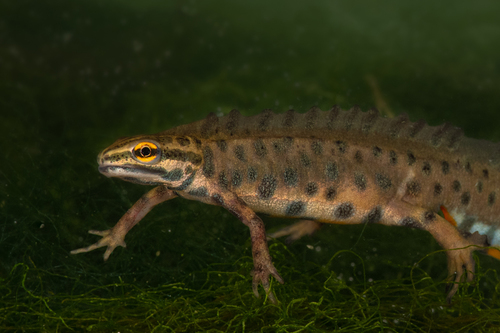
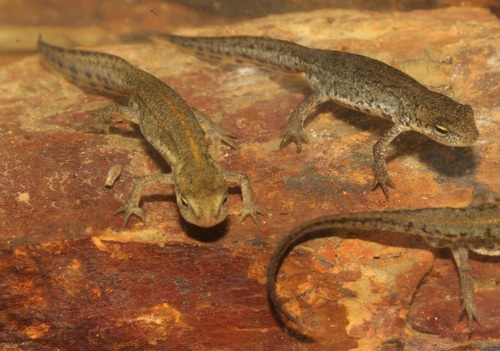
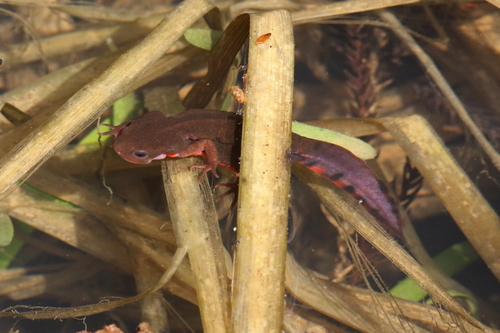
This species, Cynops pyrrhogaster, is a newt first described by Boie in 1826. On the upper body, the skin is dark brown, nearly black, and covered with wart-like bumps. The underbelly and underside of the tail are bright red with black spots. Young juveniles have creamy coloration instead of red, though most larger juveniles already show some red. Adults from smaller islands typically have more red on their ventral (belly) regions than adults from larger islands, and sometimes have extremely small black spots or none at all. In general, males have more red coloration than females. Males can also be told apart from females by their flat, wide tails and swelling around the ventral region. An entirely red color variant of this newt exists; this color trait is thought to be an inherited recessive characteristic. The variant is not limited to any single population, but it is more common across the western half of Japan. The vomeropalatine teeth, a group of teeth located in the upper back of the mouth, are arranged in two separate series. The tongue is relatively small, measuring half the width of the mouth. The nostrils are positioned anteriorly toward the snout; they are closer to each other than to the eyes and are barely visible when the newt is viewed from above. Males have longer toes than females, though females have a longer overall body length. The tail is tightly compressed, with fins along both the upper and lower edges. A smooth ridge runs from the nape of the neck to the tail. Full adult body length ranges from 8 to 15 cm (3.1 to 5.9 in). Snout–vent length ranges from 43.0 to 64.0 mm (1.69 to 2.52 in) for males, and from 48.5 to 75.0 mm (1.91 to 2.95 in) for females. Populations from more northern, higher elevation regions tend to grow larger than populations from southern, lower-altitude regions. Unfertilized eggs measure 2.1 to 2.3 mm (0.083 to 0.091 in) in length. Cynops pyrrhogaster is endemic to Japan, where it occurs on multiple islands of the Japanese archipelago, including Honshu, Shikoku, and Kyushu. It mainly inhabits the larger Japanese islands, while its close relative Cynops ensicauda lives in the Ryukyu Islands. This species has the northernmost natural range of any member of the genus Cynops; all other Cynops species, aside from C. ensicauda, are native to southern China. An introduced population of C. pyrrhogaster exists on Hachijō-jima, and this population is believed to descend from individuals originating from Shikoku. The introduction is thought to have taken place in the 1970s, but the exact method of introduction remains unknown. C. pyrrhogaster has been recorded three times in the United States, in Florida and Massachusetts. Every recorded occurrence was the result of either escape from captivity or deliberate release, and no established wild populations exist in the US. There are four distinct genetic clades of C. pyrrhogaster. The northern clade is found in the Tohoku and Kanto regions, and its range does not overlap with that of the central clade, which occurs in Chubu, northern Kansai, and eastern Chugoku. The range of the central clade has a small amount of overlap with the range of the western clade, which is found in southern Kinki, western Chugoku, Shikoku, and central Kyushu. The western clade also has some range overlap with the southern clade, which occurs in western and southern Kyushu. The newts are found at elevations ranging from 30 to 2,020 m (98 to 6,627 ft). Ecosystems that host this species include forests, grasslands, shrublands, wetlands, lakes, marshes, and cultivated areas. They can also live in human-made bodies of water, such as aquaculture ponds. Breeding takes place in paddy fields, ponds, brooks, pools, and streams. Females respond to male courtship behavior from spring to early summer. When ready to mate, both males and females produce peptide pheromones to attract the opposite sex. Males produce a pheromone called sodefrin, named from the Japanese term sodefuri meaning 'soliciting'; females produce their own distinct pheromone named imorin by its discoverers, from the Japanese term imo meaning 'beloved woman', with the suffix -rin taken from sodefrin. Both pheromones are released from the cloaca. Sodefrin was the first peptide pheromone identified in any vertebrate, while imorin was the first peptide pheromone identified in a female vertebrate. Courtship starts when the male approaches the female and sniffs her sides or cloaca. The male then positions his tail toward the female and vibrates it rapidly. The female responds by pushing the male's neck with her snout. At this stage, the male slowly moves away while undulating his tail, and the female follows. When she is close enough, she touches his tail with her snout. The male then deposits two to four spermatophores one at a time, moving several centimeters away after each deposition. The female attempts to pick up the spermatophores with her cloaca, and sometimes this attempt is not successful. Females lay eggs individually on underwater objects, such as leaves and submerged grass roots. Each egg is fertilized separately using sperm from the spermatophores the female has picked up. A female can lay up to 40 eggs in a single laying session, and 100 to 400 eggs total over one breeding season. Larvae hatch from the eggs after approximately three weeks; they are swimming, gilled larvae with a dorsal tail fin. They grow to around 3 cm (1.2 in) long during their first three months of life. Between five and six months of age, they stop eating and undergo metamorphosis, losing their gills and fins to become juveniles. Unlike larvae, juveniles cannot stay fully submerged in water without drowning. Newts at lower altitudes reach sexual maturity faster than newts at higher altitudes. Males from higher-altitude populations tend to live longer after reaching maturity, but their fully grown size is smaller than that of lowland newts. Wild C. pyrrhogaster individuals have been recorded reaching 23 years of age.