About Cynops orientalis (David, 1873)
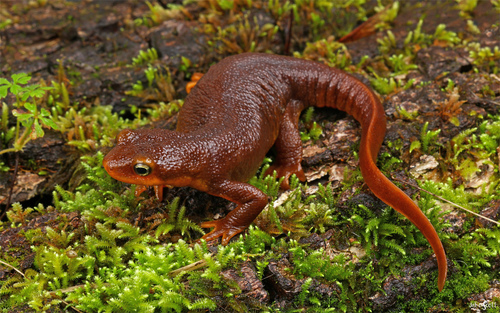
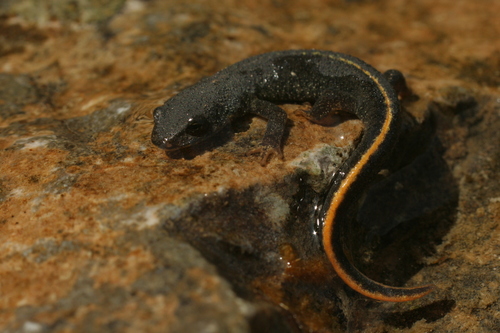
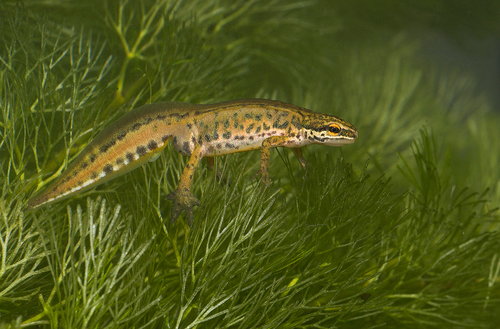
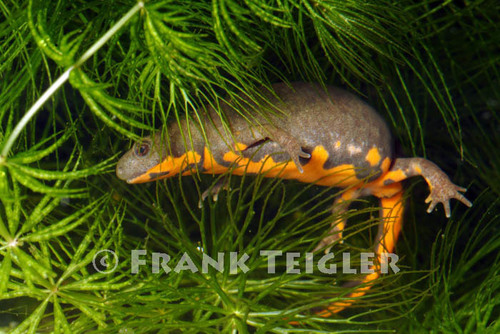
The Chinese fire belly newt, scientifically named Cynops orientalis (David, 1873), is a small black newt that measures 2.2–4.0 inches (5.6–10.2 cm) long. It has bright-orange aposematic coloration on its ventral sides. This species is commonly sold in pet stores, where it is frequently confused with the Japanese fire belly newt (C. pyrrhogaster) because the two species share similar size and coloration. Compared to C. pyrrhogaster, C. orientalis typically has smoother skin, a rounder tail, and less obvious parotoid glands. C. orientalis is endemic to subtropical forests in East-Central China. It prefers to live in shallow, semiaquatic environments, such as abandoned paddies and ponds with dense vegetation. Like many amphibians, the Chinese fire belly newt hibernates. To maintain homeostasis, clusters of melanin cells gather in the newt’s liver, which darkens the newt’s skin. Gonadal Soma-Derived Factor, shortened to gsdf, is a gene that functions in testis development in fish. Before a transcriptome study of the Chinese fire belly newt, gsdf had only been recorded in fish; this study revealed that the gene is also present in some tetrapods. For breeding ecology, Chinese fire belly newts typically spawn in ponds, ditches, wells, and fields, and prefer a water temperature between 15 and 23°C for spawning. Females usually deposit eggs on aquatic plants, and eggs take 13 to 24 days to incubate on average. The breeding season runs from March to July, with peak spawning activity in April and May. After the female retrieves the male’s spermatophore, spawning generally happens within 65 days. Recorded populations of this species have a male-biased sex ratio. Individuals of the species reach sexual maturity between 1 and 3 years of age.