About Cynomys mexicanus Merriam, 1892
The Mexican prairie dog (scientific name Cynomys mexicanus Merriam, 1892) is a diurnal burrowing rodent native to north-central Mexico. It is classified as a keystone species because of its large impact on surrounding species and the local environment. Because it has been treated as an agricultural pest, it is now categorized as an endangered species. It is closely related to squirrels, chipmunks, and marmots. This species originated approximately 230,000 years ago from a peripherally isolated population of the more widespread black-tailed prairie dog, Cynomys ludovicianus.
Mexican prairie dogs prefer to live on plains with rock-free soil, at altitudes between 1,600 and 2,200 m (5,200 to 7,200 ft). They currently occur in southern Coahuila and northern San Luis Potosí in northern Mexico, where they feed on native herbs and grasses of the local plains. In 1956, the species was reported to be present in Coahuila, Nuevo León, and San Luis Potosí; by the 1980s, it had disappeared entirely from Nuevo León. As of 1992, the species' full total range covered approximately 600 km² (230 mi²). Viewed as a pest and barrier to agriculture and cattle raising, due to their burrowing activity and regular consumption of crops, Mexican prairie dogs were often intentionally poisoned, leading to their classification as endangered in 1994. Today, the species occupies less than 4% of its original historical territory, and suffered a 33% reduction in range between 1996 and 1999. The species' current remaining habitat is the grassland region called El Tokio, located at the convergence of the states of San Luis Potosí, Nuevo León, and Coahuila. Because prairie dogs live mostly underground, accurately surveying their population size is challenging, but satellite imagery has proven helpful for mapping the areas where they reside.
Ecologically, Mexican prairie dogs get all of the water they need from the plants they eat. While they are primarily herbivorous, they have been documented eating insects. Their predators include bobcats, foxes, eagles, hawks, snakes, and weasels. They live in excavated underground colonies called "towns", which they dig for shelter and protection. A typical prairie dog town has a funnel-shaped entrance that slopes down into a corridor up to 100 ft (30 m) long, with side chambers used for food storage and nesting. Some chambers have specific dedicated uses, such as nurseries for new mother prairie dogs and their young. Prairie dogs have strong arm muscles that let them dig through the often dense soil of their habitats, and they have even been observed using their teeth for digging, though this behavior is uncommon. Prairie dog towns can hold hundreds of individuals, but most generally have fewer than 50 members, led by a single alpha male.
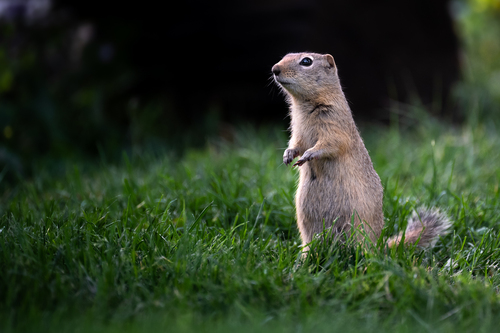
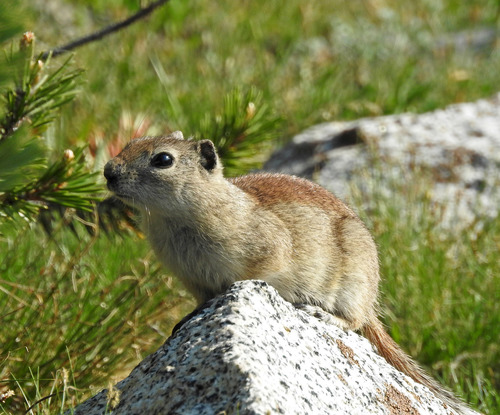
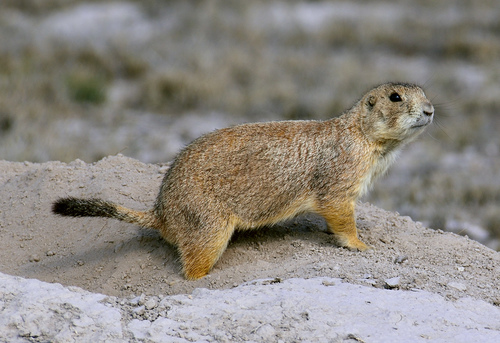
Mexican prairie dogs hibernate, and have a short mating season that usually runs from January to April. After a one-month gestation period, females produce one litter per year, with an average of four hairless pups per litter. Pups are born with closed eyes, and use their tails as visual aids until their eyes open around 40 days after birth. Weaning takes place in late May and early June, when yearlings may leave the burrow to disperse. Pups leave their mothers entirely by fall. As young prairie dogs grow, they play fighting games that include biting, hissing, and tackling. They reach sexual maturity at one year old, and have a total lifespan of 3 to 5 years. Adult Mexican prairie dogs weigh around 1 kg (2.2 lb) and measure 14 to 17 inches (360 to 430 mm) in total length, with males larger than females. Their fur is tan in color, with darker ears and a paler belly, and they have black fur on the tip of their tail. Prairie dogs have one of the most sophisticated communication systems in the animal kingdom, made up of a system of high-pitched yips and barks. Their common name comes from the fact that these calls resemble dog barks. They can run at speeds up to 35 mph (56 km/h), so their typical defense strategy is to sound an alarm call and then retreat quickly to safety.