About Cynomys gunnisoni (Baird, 1855)
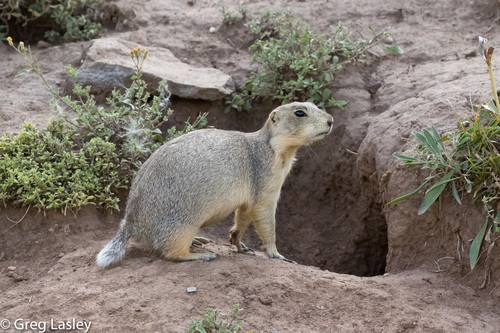
Gunnison's prairie dog, with the scientific name Cynomys gunnisoni, measures 12 to 14 inches (30 to 36 cm) in total body length, with tails ranging from 1.25 to 2.25 inches (3.2 to 5.7 cm). Adults of this species weigh between 1.5 and 2.5 pounds (0.68 to 1.13 kg). On average, males are larger than females. This species has 22 teeth and five pairs of mammary glands. C. gunnisoni is the only prairie dog species that has 40 chromosomes; all four other prairie dog species—the black-tailed, white-tailed, Utah, and Mexican prairie dogs—have 50 chromosomes. Their coats are a yellow-toned buff mixed with black hairs. The upper head, cheek sides, and eyebrows are distinctly darker than the rest of the body. Their tails are mostly white with grayish-white ends, and the tail tips are light gray. Gunnison's prairie dogs molt twice per year, once in spring and once in fall. In spring, shedding progresses from the head to the tip of the tail. The direction reverses in fall, with shedding starting at the tail and moving toward the head. A key physical trait of this prairie dog is the placement of its eyes: they sit on the sides of the head, giving the animal a wide peripheral range of sight that lets it spot predators more easily and react quickly. Three-quarters of the entire global population of Gunnison's prairie dogs lives in Arizona and New Mexico. They inhabit high desert, grasslands, meadows, hillsides, broad alluvial valleys, and floodplains, and are often found among shrubs including rabbitbrush, sagebrush, and saltbrush. They occupy habitats at altitudes between 6,000 and 10,000 feet (1,800–3,000 m), though individuals have been recorded at altitudes as high as 12,000 feet (3,700 m). The sagebrush ecosystem depends on Gunnison's prairie dogs. Their burrowing activity freshens soil, adds organic matter to soil, and increases water penetration into the ground. Their burrows also create new habitats and expose food sources for other types of creatures.