About Cynomya cadaverina Robineau-Desvoidy, 1830
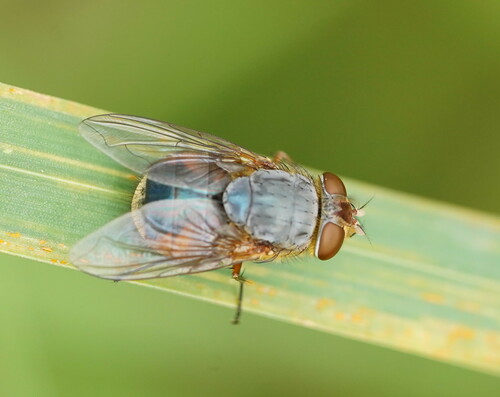
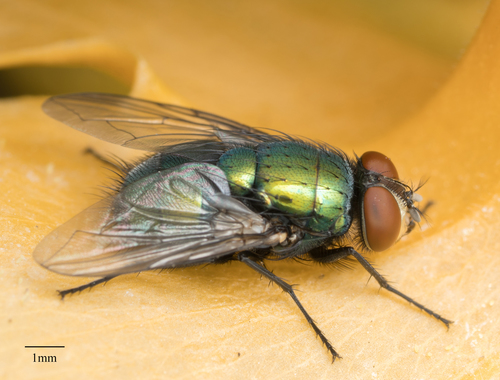
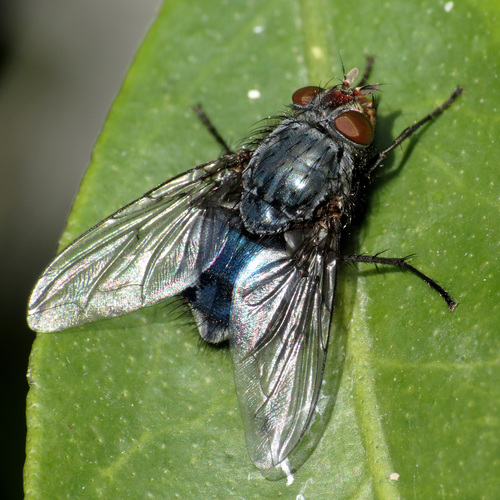
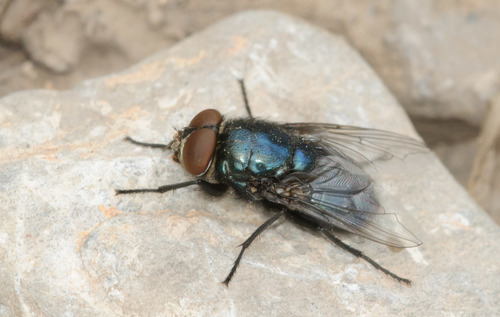
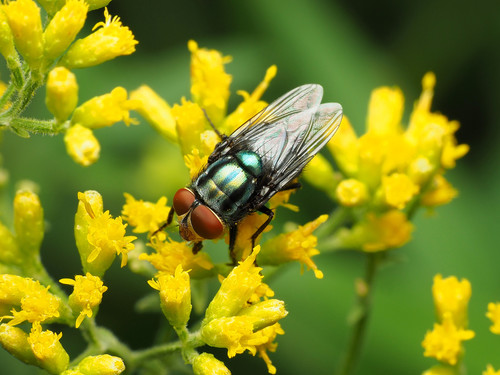
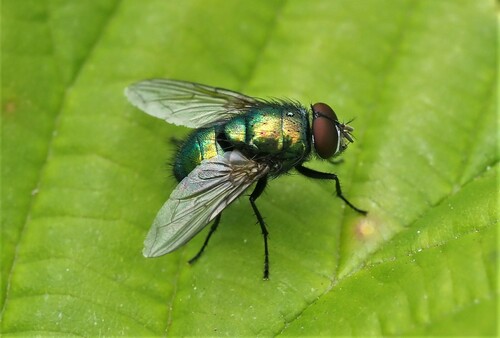
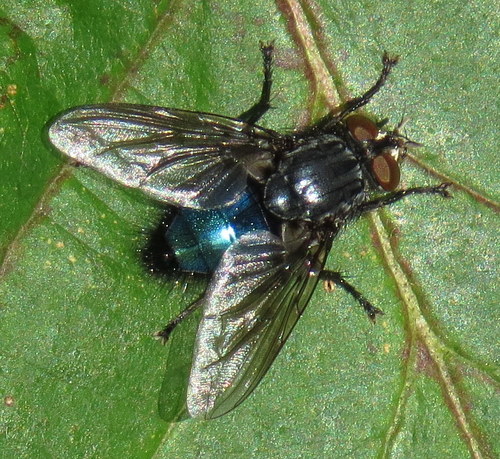
Cynomya cadaverina is a fairly large species, ranging from 9 to 14 millimeters in length. It has many characteristics shared by other members of its family, Calliphoridae, including a metallic body, bristles on the meron, and a plumose arista. This species is named for its shiny metallic blue abdomen. It has a dark blue or black thorax, with distinctive darker blue stripes on the dorsum behind the head. Other identifying features include white calypters, a bare stem vein, and a parafacial with a black to reddish brown ground color covered in a yellow layer. Cynomya cadaverina is distributed across the Nearctic region; it is found mostly in southern Canada and the northern United States, but has also been recorded as far south as Florida and Texas. This is a cool weather species, and reaches its highest population numbers on carrion during the spring and fall months. Most often, it overwinters in the adult stage, and may enter houses during the overwintering period. As a member of the order Diptera, C. cadaverina has a holometabolous life cycle, meaning it progresses through four distinct life stages: egg, larva, pupa, and adult (imago). Under suitable conditions, C. cadaverina typically produces around 17 generations of offspring per year, with 25 to 50 eggs per generation. Temperature has an extreme effect on development: if temperatures go above or below a specific range, all development stops. In general, warmer temperatures speed up the life cycle, while colder temperatures slow it down, a factor that must be considered when estimating postmortem interval. Adult C. cadaverina lay eggs in open wounds or natural body openings of carrion, usually in small clusters or scattered individually. Eggs hatch between 24 and 72 hours after being laid, depending on the season. After hatching, larvae go through three separate instar stages, each separated by a molt. During a molt, the larva sheds its outer layer to allow for new growth, which occurs as it consumes food to build energy stores. The first instar typically lasts approximately 20 hours, the second instar lasts 16 hours, and the third instar lasts 72 hours. Once larvae finish development and store enough energy, they disperse to a safe location to enter the pupal stage. The pupal stage lasts around 9 days before the adult fly emerges. Depending on temperature, the full life cycle of C. cadaverina takes between 17 and 19 days total.