About Cynarina lacrymalis (Milne Edwards & Haime, 1849)
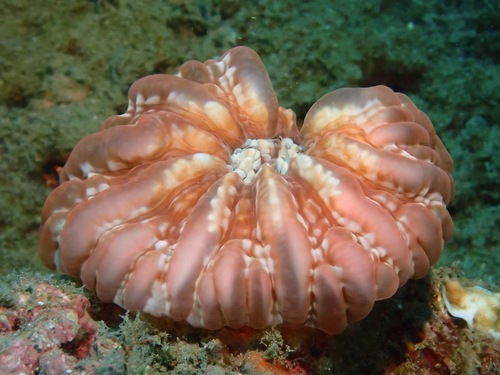
Cynarina lacrymalis is a large, solitary coral species that hosts a single polyp within a stony, secreted cup called a corallite. It can reach 10 cm (3.9 in) in diameter and 8 cm (3.1 in) in height, with a cylindrical shape and a round or oval upper surface. It usually attaches to rock, but has a pointed base that allows it to become embedded in sand or survive without being attached. It has twelve broad white radially arranged septa (ridges) connected to the corallite wall, with secondary septa between these primary septa for a total of 96 septa. The coral's costae, which are extensions of the septa, alternate between thick and thin according to whether they extend from a primary or secondary septa. Costae have large, rounded lobes, and the short, broad central axial structure (columella) located in the corallite. The septa are visible through the coral's transparent, fleshy mantle, which contains symbiotic flagellates called zooxanthellae that give the coral its color. This color is usually pale brown or green, sometimes with a contrasting oral disc, and may also be pinkish or bluish; the exact color depends on which species of zooxanthella resides in the coral. This coral can change the texture of its surface from glossy to dull, though the reason for this change is not currently understood. At night, when the polyp extends its many tentacles to feed, Cynarina lacrymalis resembles a sea anemone. Cynarina lacrymalis is distributed in the Red Sea and Gulf of Aden, along the east coast of Africa, in the Seychelles, Japan, Indonesia, and northern and eastern Australia. It inhabits shallow reefs and sandy seabeds with moderate water flow, and can be found at depths down to 40 metres (130 ft). Cynarina lacrymalis is kept as a species in aquaria. It can be propagated in captivity and is relatively easy to care for, though its slow growth rate makes it a niche species that is rather expensive. In captivity, it requires moderate light, and can be given supplemental feedings of meaty foods such as brine shrimp, krill, or chunks of fish. While the species itself is not aggressive, it should be kept separate from other corals because it can be overtaken by them.