About Cynara cardunculus L.
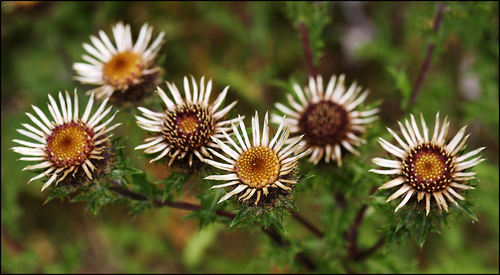
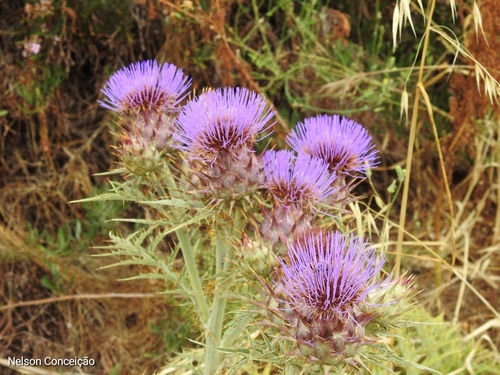
Cynara cardunculus L., commonly known as wild cardoon, is a stout herbaceous perennial plant that reaches heights of 0.8 to 1.5 m (31 to 59 in). Its leaves are deeply lobed, heavily spined, and range in color from green to grey-green; they are covered in dense hair-like tomentose fuzz, and can grow up to 50 cm (20 in) long, with yellow spines that reach up to 3.5 cm long. The plant produces violet-purple flowers that form large, globose, heavily spined capitula up to 6 cm (2 in) in diameter. Wild cardoon is adapted to dry climates, and is native across a circum-Mediterranean area, ranging from Morocco and Portugal east to Libya and Greece, and north to Croatia and Southern France. It may also be native to Cyprus, the Canary Islands, and Madeira. In France, this frost-tender species only grows wild in Mediterranean southern regions: Gard, Hérault, Aude, Pyrénées-Orientales, and Corsica. It has become an invasive weed in the pampas of Argentina, and is also classified as a weed in Australia and California. The “giant thistle of the Pampas” documented by Charles Darwin has been identified as this species. There are two main cultivar groups within the Cynara cardunculus complex, both derived from the wild cardoon subspecies C. cardunculus var. sylvestris (Lam.) Fiori. The first is cultivated cardoon (Cynara cardunculus Cardoon Group, synonym C. cardunculus var. altilis DC), which was selected for its edible leaf stems. The second is the artichoke (Cynara cardunculus Scolymus Group, sometimes classified as a separate species Cynara scolymus or as C. cardunculus var. scolymus (L.) Fiori), selected for its larger edible flower buds. Cultivated varieties differ from the wild plant in being larger, growing up to 2 m tall, much less spiny, with thicker leaf stems and larger flowers. All of these traits were intentionally selected by humans to increase crop yield and make harvest and processing easier. Wild cardoon, cultivated cardoon, and artichoke are very similar genetically, fully interfertile, and only have very limited ability to form hybrids with other species in the genus Cynara. The earliest known written description of cardoon may come from the fourth-century BC Greek writer Theophrastus, who referred to it under the name κάκτος (Latinized as cactus), though the exact identity of the plant he described is uncertain. Cardoon was a popular ingredient in Greek, Roman, and Persian cuisine, and remained common in cooking through medieval and early modern Europe. It also became widely grown in the vegetable gardens of colonial America, but fell out of common use in the late 19th century and is now very uncommon in North America. In Europe, cardoon is still cultivated in France’s Provence, Savoie, and Lyonnais regions, as well as in Spain and Italy. In the Geneva region of Switzerland, Huguenot refugees introduced the plant around 1685, and the local cultivar Argenté de Genève, also called “Cardy”, is considered a regional culinary specialty. Before cardoons are served, the leaf stalks or ribs are blanched: the stalks are tied together, wrapped entirely in straw secured with cord, and left to blanch for about three weeks. Cardoons are also a common vegetable in northern Africa, frequently used in Algerian or Tunisian couscous. Raw cardoon stalks can be covered with small, nearly invisible spines that can cause significant pain if they become lodged in the skin. Several spineless cultivars have been developed to avoid this issue. Cardoon requires a long, cool growing season of approximately five months. While it is not particularly sensitive to light frost, heavy freezes can cause it to lose its leaves before resprouting, and extended deep freezes will kill the plant. It also requires a large amount of growing space per individual plant, so it is not widely grown outside of regions where it remains popular. In cultivation in the United Kingdom, this plant has received the Royal Horticultural Society's Award of Garden Merit. Cardoons serve as a vegetarian source of enzymes for cheese production. In Portugal, traditional curd coagulation relies entirely on this plant-based vegetable rennet, which is used to produce protected designation cheeses such as Serra da Estrela and Nisa. Cardoon is also grown as an ornamental plant, valued for its imposing architectural appearance, and selected cultivars feature bright silvery-grey foliage and large flowers. In recent years, cardoon has drawn attention as a potential source of biodiesel fuel. Oil extracted from cardoon seeds is called artichoke oil, and it is similar to safflower and sunflower oil in both composition and use. Cardoon is the feedstock for the world’s first biorefinery, which converted the installations of an existing petrochemical plant in Porto Torres, Sardinia, to produce biomass and oils that serve as building blocks for bioplastics.