About Cynanthus forficatus (Ridgway, 1885)
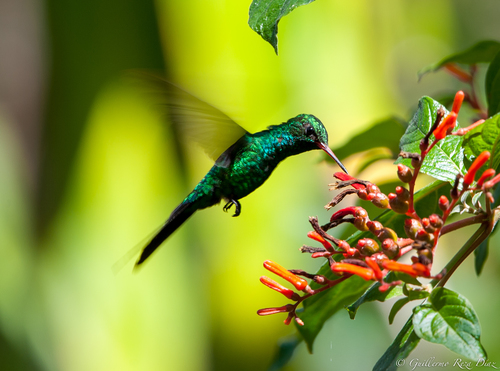
Cozumel emerald is scientifically named Cynanthus forficatus (Ridgway, 1885). Males measure 9 to 10.5 cm (3.5 to 4.1 in) in length, while females measure 8 to 9.1 cm (3.1 to 3.6 in). Both males and females weigh approximately 2.5 g (0.088 oz). Males have a black bill with a red tip. Their crown is bright golden to golden green, and the rest of their upperparts are a slightly duller golden green. Their underparts are brilliant metallic golden green, with white tibial tufts. Males have a long, deeply forked tail that is blue-black or black with a blue gloss; the central two or three pairs of tail feathers have dark brownish gray tips. For females, the maxilla is black and the mandible is red with a black tip. Female upperparts are bright metallic green to bronze green. Females have a white stripe behind the eye and blackish cheeks. Their underparts are light gray. A female's tail is not as long or as deeply forked as a male's. The central pair of a female's tail feathers are metallic green to blue green. The next two pairs share this base color, with a blue-black or black band near the end and white tips. The outermost two pairs have white outer webs at their base, a wide black band near the end, and white tips. The Cozumel emerald is essentially found only on Cozumel Island, off the coast of Mexico's Yucatán Peninsula. There is one known specimen from Isla Mujeres, which is about 90 km (56 mi) north of Cozumel, and the species is thought to occasionally visit this island. Recorded habitats for the species include "scrub and low deciduous insular forest" and "brushy woodland and scrub, second growth".