About Cynanthus canivetii (R.Lesson, 1832)
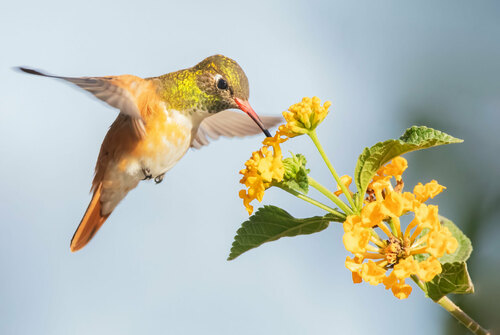
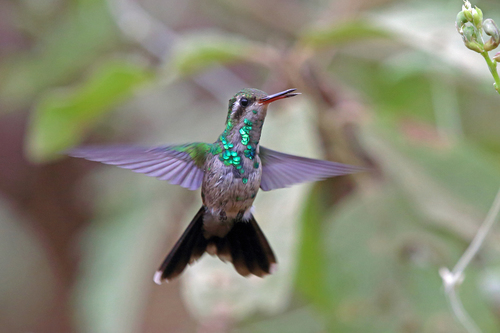
Canivet's emerald (scientific name Cynanthus canivetii (R.Lesson, 1832)) has distinct size and plumage differences between males and females, and between its three recognized subspecies. Males measure 7.8 to 9.3 cm (3.1 to 3.7 in) in length and weigh 2.1 to 2.8 g (0.074 to 0.099 oz). Females are 7.5 to 8.6 cm (3.0 to 3.4 in) long and weigh approximately 2.3 g (0.081 oz). For males of the nominate subspecies, the bill is red with a black tip. The crown is bright golden to golden green, and the rest of the upperparts are a less brilliant golden green. The underparts are brilliant golden green with white tibal tufts. The tail is long and forked, blue-black or black with a blue gloss, and the central two or three pairs of tail feathers have dark brownish gray tips. For females, the maxilla is black, while the mandible is red with a black tip. The upperparts and flanks are bright metallic green to bronze green, with a duller shade on the crown. Females have a grayish white stripe behind the eye and dusky cheeks, and their underparts are light gray. The female's tail is not as long or as deeply forked as the male's. The central pair of female tail feathers is metallic green to bluish green; the next three pairs are the same color, with a black band near the end and white tips. The outermost pair has a dusky base and brownish gray and black bands near the end. Subspecies C. c. osberti is similar to the nominate subspecies, but males of this taxon have a shorter, less deeply forked tail, and the gray tips on their central tail feathers are narrower and darker. Males of C. c. salvini are also similar to the nominate, but have a dusky rather than red maxilla, and dark sooty gray tips on the central tail feathers. Each of the three subspecies has a separate geographic range. The nominate subspecies occurs in eastern Mexico from Tamaulipas to Yucatán, and extends through Belize and northern Guatemala into Honduras, including Honduras' offshore islands. C. c. osberti is found from Chiapas in southern Mexico through central and western Guatemala, El Salvador, and Honduras into western Nicaragua. C. c. salvini occurs on the Pacific side of northwestern Costa Rica. The species as a whole inhabits arid to semi-humid, semi-open to open landscapes. These include evergreen forest edges and clearings, secondary forest, scrubby savannas, and gardens. Across most of its range, it is found from sea level up to 1,900 m (6,200 ft); in Costa Rica, it only occurs up to about 1,500 m (4,900 ft).