About Cynanchica pyrenaica (L.) P.Caputo & Del Guacchio
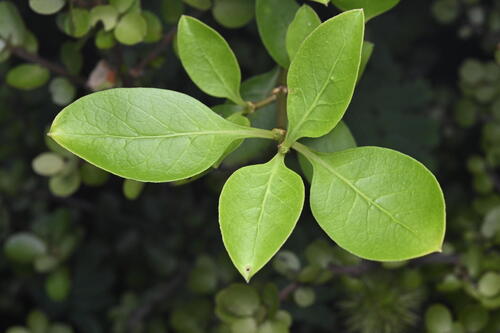
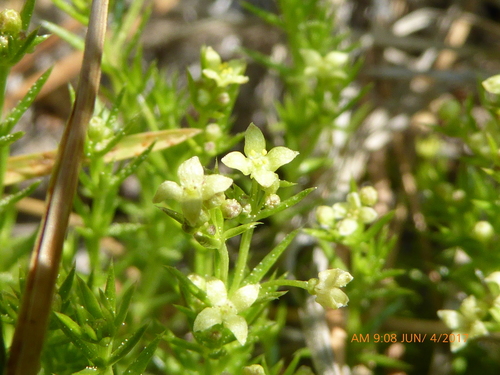
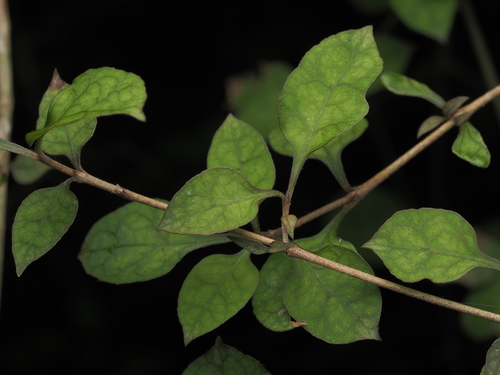
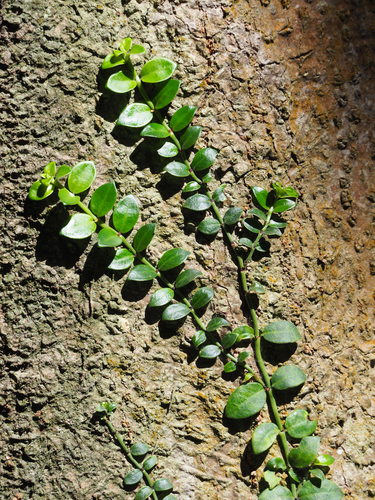
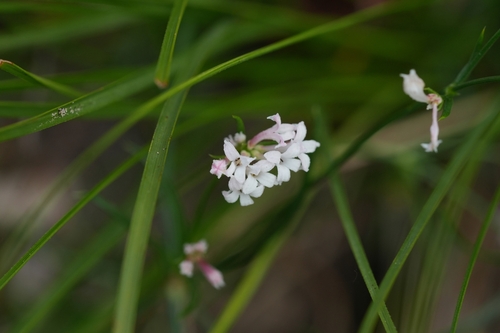
Cynanchica pyrenaica, commonly called squinancywort, is a delicate herbaceous perennial, growing in a prostrate to ascending form. It has weak stems that sprawl across the ground or scramble through other vegetation. This rhizomatous species typically forms a loose patch up to 40 cm across, with exceptional patches reaching 1 m across. Patches are interspersed among other plants and are often concealed within grassland. Its green, heavily branched stems are square in cross-section, with winged corners. Stems are roughly hairy toward the base and hairless toward the tips. Lower leaves are elliptical, while upper leaves are narrow and linear. All leaves are entire (unlobed and untoothed), and taper to a pointed tip. Foliage appears to grow in whorls of four; however, at each node there are technically 2 leaves (around 20 mm long) plus 2-4 leaf-like stipules that are often much shorter than the leaves. All foliage is hairless. Inflorescences grow from leaf axils and stem tips, forming few-flowered cymes. Individual flowers are small, 3–4 mm across, and typically white, with a pinkish tint on the backs of the petals. They often have darker pink veining patterns on the corolla lobes. Each flower forms a tube around 5 mm long, with 4-5 lobes at the opening, and carries a vanilla scent. The calyx is shorter than the corolla tube, with 4 shallow lobes. Each bisexual flower contains 4 stamens, one style, and an inferior ovary. The fruits are warty nutlets. Squinancywort is native to Europe, western Asia, and parts of North Africa, growing in areas with chalk, limestone, or coastal sand. It is not globally rare or threatened. It is generally a lowland plant, found from sea level up to 305 m in Ireland, but can grow above 2,300 m in the Pyrenees. In Britain, it is considered an indicator of unimproved grassland, and classified as an axiophyte in every county where it occurs. While it is thought to be threatened by agricultural improvement and is in decline, it remains as widespread as it has ever been. Squinancywort grows in short, species-rich grassland established over chalk or limestone; in Britain it occurs in CG2 Festuca ovina - Avenula pratensis grassland. It is also found on dunes in south Wales. Under Universal adaptive strategy theory, it is a strongly stress-tolerant plant, though it acts more as a ruderal when growing on sand. Some authorities classify these sand-dwelling plants as a separate subspecies, ssp. occidentalis. Its environmental preferences are shown in its Ellenberg-type indicator values: it has high values for light (7) and pH (8), meaning it favours full sunlight and alkaline conditions, and low values for moisture (3), nutrients (2), and salt (0). A study of plants associated with yellow meadow ant hills in Oxfordshire found that while squinancywort occasionally grows on anthills, there is no statistically significant association between the two. Its seeds do not have an elaiosome, which suggests they are not dispersed by ants. Known pests of squinancywort include the micromoths Cataclysme riguata and Watsonarctia deserta, whose larvae feed on its leaves; the beetle Timarcha tenebricosa, which feeds exclusively on bedstraws including squinancywort; several species of fungi, including the genus-specific rust Puccinia asperulae-cynanchicae; the mite Aculus minutus, which galls inflorescences and turns flowers green and leaf-like; the midge Schizomyia galiorum, which forms galls on flowers that swell into green or violet balls; and dodder, a parasitic plant that grows on its stems. Only the last three of these pests have been recorded in Britain. There is no evidence that squinancywort was ever used to treat quinsy. A small number of modern writers have made this assumption, likely based on the plant's common name. However, Mrs Grieve noted in the 1920s that the plant was "no longer applied in medicine", and Geoffrey Grigson stated in 1955 only that it was an old remedy. Folklore researchers have found no support for the quinsy cure claim, and botanical names do not always carry clear implied meanings. The common name likely comes from a superficial resemblance between squinancywort's flowers and those of sword-leaved dogbane; sword-leaved dogbane was reportedly used in Ancient Rome to kill dogs and leopards, and to dissolve their lips. Early herbalists such as Culpeper do not attribute quinsy-curing properties to squinancywort; Culpeper recommended cudweed, hyssop, orpine, ragwort, and blackberry as quinsy treatments, but not squinancywort. The name cynanchica was first applied to this plant by Bauhin in 1623; at that time, Bauhin considered it effective only against angina when taken and applied externally. Mrs Grieve also reported that roots of this plant have been used as a red dye in Sweden.