About Cymodocea nodosa (Ucria) Asch.
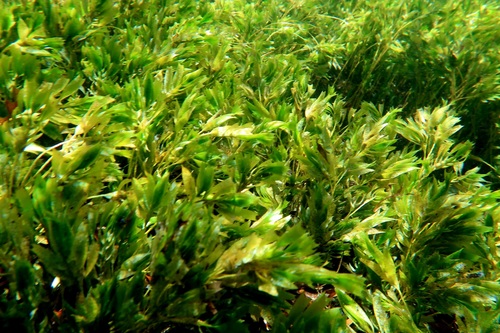
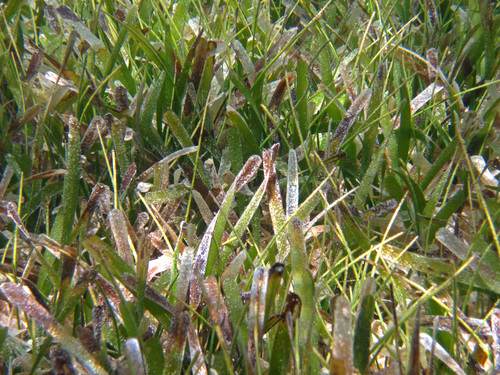
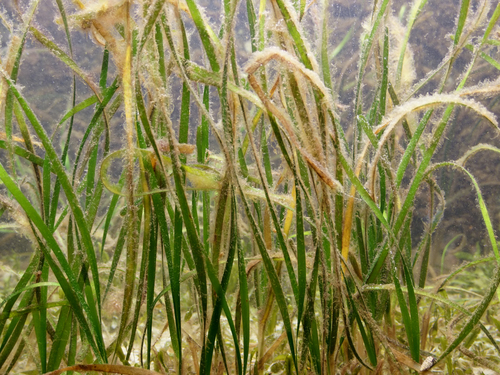
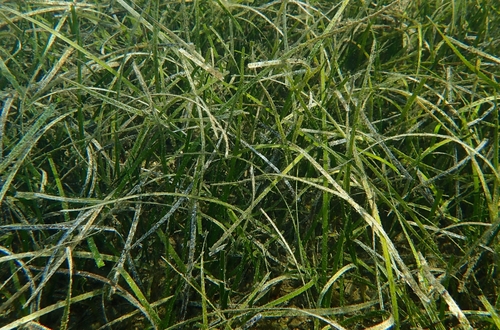
Cymodocea nodosa, a species of seagrass, has light green or greyish-green leaves. The leaves are very narrow, and can grow up to 40 centimetres (16 inches) long. Each leaf has seven to nine veins that run along its length. This seagrass produces rhizomes that are only 1 mm in diameter, with leaf scars spaced at intervals along the rhizomes. Inconspicuous, grass-like flowers sometimes develop at the end of long stems in spring, when water temperatures start rising after reaching their winter minimum. Pollen from this species is released into the sea, and its seeds remain dormant until the following spring. This seagrass is distributed in shallow areas of the Mediterranean Sea and adjacent parts of the Atlantic Ocean, including the coasts of Portugal, Mauritania, Senegal, and the waters around the Canary Islands and Madeira. It grows in sheltered locations with sandy sediments at depths down to 19 metres, and requires clear water to carry out photosynthesis. Off the Catalan coast in the western Mediterranean, a single meadow of this seagrass covering at least 800 hectares (2,000 acres) has been found. Cymodocea nodosa grows in seabed meadows, and is sometimes found alongside other seagrass species Zostera noltii and Posidonia oceanica, and seaweeds Caulerpa prolifera and Caulerpa racemosa. While it is negatively impacted by mechanical disturbance such as trawling, by pollution, and faces competition from other seagrass species, C. nodosa is not considered a threatened species. In the Canary Islands, 53 species of epiphytic algae have been recorded growing on the leaves and rhizomes of C. nodosa, most of which are encrusting species in the family Corallinaceae. Seagrass meadows have high biological productivity and form rich, biodiverse habitats. In a coastal lagoon in southeast Spain, fish species associated with C. nodosa meadows include Atherina boyeri, Pomatoschistus marmoratus, Liza aurata, Liza saliens, Syngnathus abaster and Aphanius iberus. These meadows serve as important rearing grounds for juvenile fish. Invertebrates commonly found in these seagrass meadows include polychaete worms, amphipods, isopods, decapods and molluscs. C. nodosa typically grows in patches, because it favours unstable sandy sediments, and subaqueous dunes shift over time. If sand accumulates slowly enough, the seagrass's stolons can grow vertically through the new sand, but rapid sand accretion can overwhelm and kill the plants. Patch death is most often caused by erosion, which exposes roots, increases activity by encrusting and drilling organisms, and eventually sweeps the plants away. The subaqueous dune movement cycle usually takes between two and six years, which gives C. nodosa enough time to recolonize newly bare areas. Sand accumulation also stimulates flowering, and dormant seeds allow recolonization when growing conditions become suitable. The changing growth pattern of C. nodosa in response to sand deposition can be used to measure the movement of subaqueous dunes. In Alfacs Bay, located in the northwest Mediterranean Sea, dune advance was found to average 13 metres (43 ft) per year, and C. nodosa can be used to monitor dune movement rates ranging from 0.15 metres (5.9 in) to 980 metres (3,220 ft) per year. The invasive alga Caulerpa taxifolia is often associated with C. nodosa. This alga has an extensive rhizoidal system that anchors it to sandy substrates, and it is more efficient at extracting nutrients from the substrate than C. nodosa. A study conducted near Elba, Italy added slow-release fertiliser sticks to test plots of seabed where both the alga and seagrass grew. While both species showed increased growth rates with added nutrients, C. nodosa was relatively disadvantaged: increased growth of Caulerpa taxifolia reduced the amount of sunlight that reached C. nodosa, while the alga was less limited by reduced light availability.