About Cymbirhynchus macrorhynchos (Gmelin, 1788)
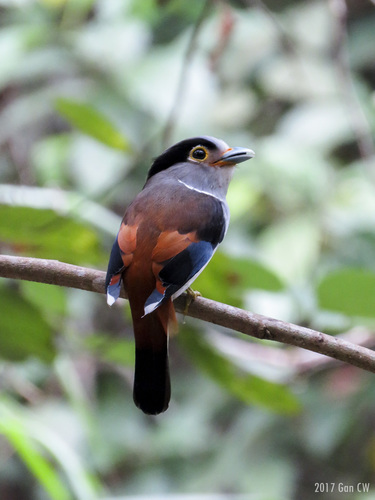
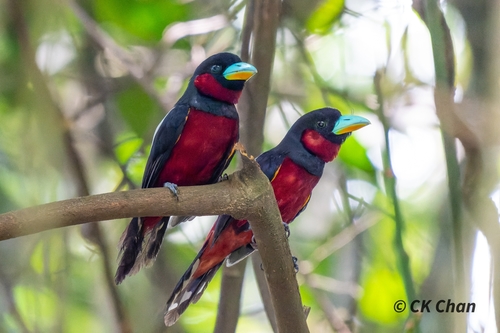
The black-and-red broadbill (Cymbirhynchus macrorhynchos) is a large broadbill with distinctive plumage that cannot be confused with any other species occurring within its range. Average adult individuals measure 21–24 cm (8.3–9.4 in) in length, have wing lengths of 9.7–10.8 cm (3.8–4.3 in), and weigh 51–65 g (1.8–2.3 oz). Males and females are similar in appearance, but the species shows slight sexual dimorphism, with females being smaller than males. Adult black-and-red broadbills have black heads and breastbands, greenish-black upperparts, a maroon half-collar, and bright maroon rumps and uppertail coverts. The shoulder-blade outer edge scapular feathers have pure white edges, which create a white line on the closed wing. The bend of the wing has a narrow orange line. The tail is black, with variable amounts of white. The bill is two-colored: the maxilla is bright turquoise-blue, while the mandible is yellow-orange with a blue tip and edges. The irises are bright emerald green, and the feet are bright blue, sometimes with a violet tinge. Immature birds are similar to adults, but have browner upperwings, white spots at the tips of the median wing coverts (the second row of wing coverts), and purple irises. Juveniles have much duller plumage, with sooty brown upper parts, maroon patches on the rump and uppertail coverts, brown underparts and wings, and white patches on the outer webs of the scapulars. They also have blackish to brownish-blue bills, bronze irises, and dull blue-grey feet. The species' brilliant red plumage comes from the biological pigment 2,3-didehydro-papilioerythrinone, which is also found in red-plumaged birds of the genera Sarcophanops and Eurylaimus. One of the black-and-red broadbill's most striking features is its large, boat-shaped bill. It is thought that the wide bill and gape first evolved in the common ancestor of all broadbills, as an adaptation to an insectivorous diet. The black-and-red broadbill also has a large, fleshy tongue that helps manipulate objects inside its beak. The black-and-red broadbill is distributed across Brunei, Cambodia, Indonesia, Laos, Malaysia, Myanmar, Singapore, Thailand, and Vietnam. In peninsular Thailand, it has disappeared locally from some areas. It was common in Singapore until the 1940s, after which there were no confirmed records until 2004, followed by another record in 2020. Across most of its range, it primarily inhabits riparian forest edges at altitudes up to 300 m (980 ft), though it can occasionally be found at altitudes as high as 900 m (3,000 ft). In further downstream areas, it lives in screw-palm swamps near mangrove edges. In areas heavily affected by land conversion, it can be found in rubber plantations, coconut groves, or orchards with water channels. It has also been observed in peat swamp forest, but rarely enters closed-canopy forest. It adapts well to disturbed habitat, surviving in secondary forest that still retains some tall trees, as well as in secondary vegetation with forest clumps in pastureland. It also lives in heavily degraded habitats along rivers. In terms of behavior and ecology, the black-and-red broadbill is most often found alone, in pairs, or in small family groups. It is known to roost in small groups. Occasional records exist of multiple adults vocalizing together, which are thought to be territorial encounters. The species has a generation length of three years.