About Cymbiola nobilis (Lightfoot), 1786
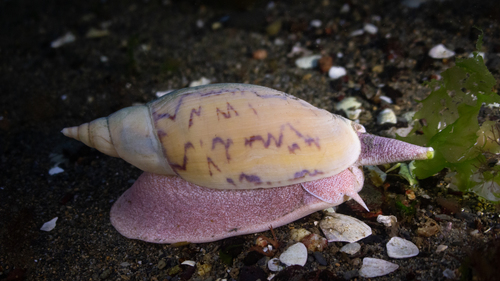
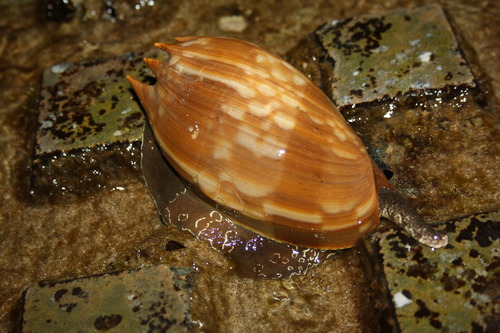
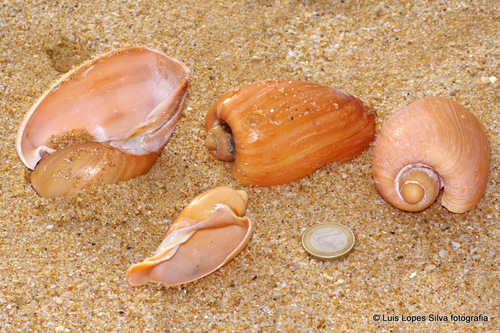
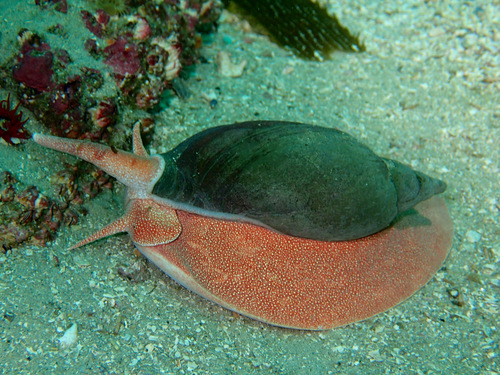
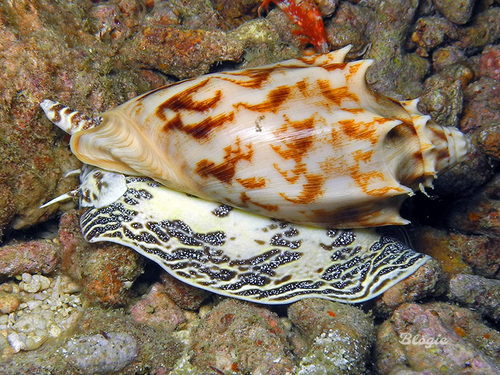
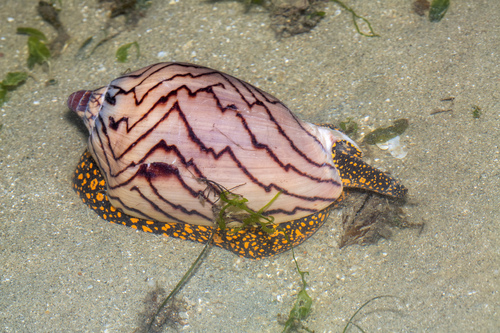
Cymbiola nobilis (Lightfoot), 1786 has shells that range in length from 50 to 222 millimeters (2.0 to 8.7 inches), with an average size of 6 centimeters. Females of this species are typically larger than males. These fairly large, thick, heavy shells are glossy, with folds called plaits on the columella, and they show a wide range of pattern variation. Shell color can be beige, orange, or yellow, with a zig-zag red or brown pattern, and some individuals have completely black shells. The snail's soft fleshy body is black, marked with bright yellow or orange spots. Pigment-producing cells infect neighboring cells, causing those cells to also produce pigment; after one infection, cells become unable to produce pigment again. This process creates the species' characteristic shell color patterns. Cymbiola nobilis is widely distributed across Asia, occurring from Taiwan to Vietnam, Peninsular Malaysia, Indonesia, Singapore, and the Philippines. This marine species lives on sandy reef flats, and in sandy areas adjacent to coral rubble and seagrasses. Its populations occur in small, isolated patches that are often close to one another, but separated by geographic barriers like water channels. Each isolated population has its own distinct shell shape and color pattern. Cymbiola nobilis is partially hermaphroditic, but also has separate sexually distinct individuals, and it reproduces sexually. Males fertilize females internally, after which females deposit fertilized eggs. Each egg capsule produced by a female contains multiple embryos. Eggs hatch into larvae after approximately seven days. Embryos develop into free-swimming planktonic marine trochophore larvae, and later grow into juvenile veligers. In total, the species goes through eight distinct developmental stages before reaching full adult form.