About Cymbilaimus lineatus (Leach, 1814)
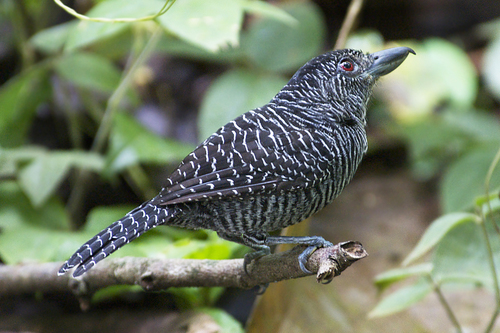
The fasciated antshrike, Cymbilaimus lineatus (Leach, 1814), measures 17 to 18 cm (6.7 to 7.1 in) long and weighs 35 to 40 g (1.2 to 1.4 oz). This species shows significant sexual dimorphism. All subspecies of both sexes have a red iris and a heavy hooked bill, similar to the bills of true shrikes. Adult males of the nominate subspecies C. l. lineatus have a black forehead and crown marked with a few very thin white bars, and the rest of their plumage has thin alternating black and white bars. Females have a rufous crown; most of the rest of their plumage has thin alternating dark brown and pale yellowish brown bars, and their tail is barred with dark brown and pale buff. Subadult males resemble adult males but have wider white bars. Males of the subspecies C. l. fasciatus have bold contrasting black and white bars on the forehead, while their crown is entirely black. Females of this subspecies have brown and cinnamon bars on their tail. Subspecies C. l. intermedius is similar to C. l. fasciatus, but has wider pale bars on its tail. The plumage of these two subspecies varies individually and with age, leading to overlapping appearance between them. The fasciated antshrike has a disjunct distribution, with the range of northernmost subspecies C. l. fasciatus separate from the larger combined range of the other two subspecies. C. l. fasciatus occurs from El Paraíso Department in southeastern Honduras, south through Nicaragua and Costa Rica along the Caribbean slope, and through Panama on both the Caribbean and Pacific slopes (it occurs only locally on Panama's Pacific slope). Its range continues into Colombia's Magdalena River Valley, east into northwestern Venezuela, and south along the Pacific slope into northwestern Ecuador as far as northern Los Ríos Province. C. l. intermedius is found from southern Colombia and Venezuela, south through eastern Ecuador and eastern Peru into Bolivia, and east from this western limit into northwestern and southern Amazonian Brazil as far as Tocantins and Goiás. The nominate subspecies C. l. lineatus is found from eastern Bolívar state in Venezuela, east through Guyana and Suriname into French Guiana, and south into Amazonian Brazil north of the Amazon River between the Branco and Negro rivers. The fasciated antshrike inhabits primary and secondary evergreen forest in lowlands and Andean foothills. In Central America, it tends to occupy second growth and thickets rather than forest interior. In other parts of its range, it occurs in forest interior and also commonly uses forest edges. Across all areas, it favors vine tangles and dense mid-storey vegetation. In terms of elevation, it occurs below 400 m (1,300 ft) in Honduras, and below 800 m (2,600 ft) across most of the rest of its range. It reaches elevations of 1,200 m (3,900 ft) in Brazil and Costa Rica, 1,400 m (4,600 ft) in Colombia, and 1,300 m (4,300 ft) in Venezuela. In Ecuador and Peru it occurs up to 1,000 m (3,300 ft), though it occurs locally up to 1,500 m (4,900 ft) in Peru. The ranges of the fasciated antshrike and the bamboo antshrike overlap, but bamboo antshrikes generally occur at higher elevations than fasciated antshrikes.