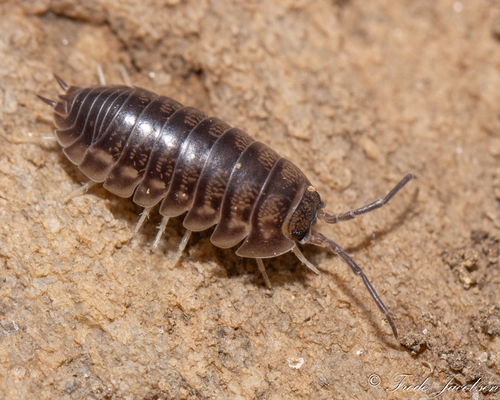
About Cylisticus convexus (De Geer, 1778)
Cylisticus convexus (De Geer, 1778) is able to conglobate, but its antennae and long pointed uropods still protrude when it does so. This characteristic, along with its five pairs of pleopodal lungs, distinguishes it from Armadillidium species and Eluma caelata, which have truncated square-shaped uropods and only two pairs of pleopodal lungs. Males of this species reach a maximum length of 9.0 mm, while females reach a maximum of 10.0 mm. The body of Cylisticus convexus is elongated and convex. Its cephalon has nearly square lateral lobes that are directed obliquely outwards. Each eye contains 22 ommatidia. On its antennae, the fifth article of the peduncle is longer than the flagellum; the flagellum has two articles, with the distal and proximal articles nearly equal in length. Its mandibles have a molar penicil formed from numerous setae that grow from a single stem. Its maxilla is two-lobed, with both lobes covered in setules. The inner lobe is larger than the outer lobe, and bears scattered spines. This species is native to Europe and Asia. It has been introduced to North Africa, North America, and South America. It lives in ground habitats near buildings. Like other pillbugs, Cylisticus convexus is a nocturnal detritivore that feeds primarily on dead wood and leaf litter.

