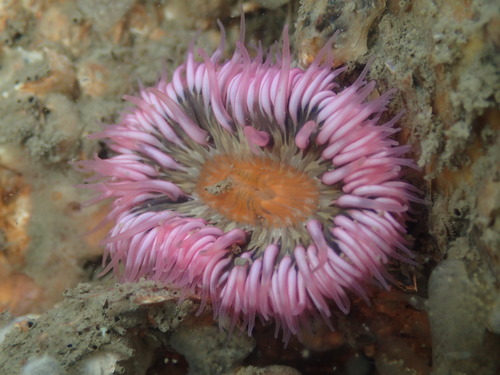
About Cylista troglodytes (Price, 1847)
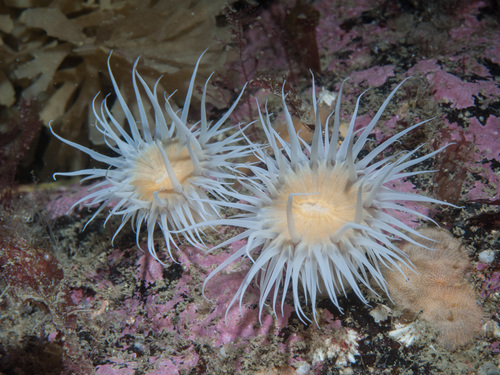
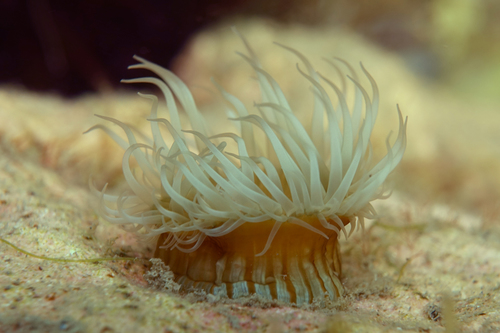
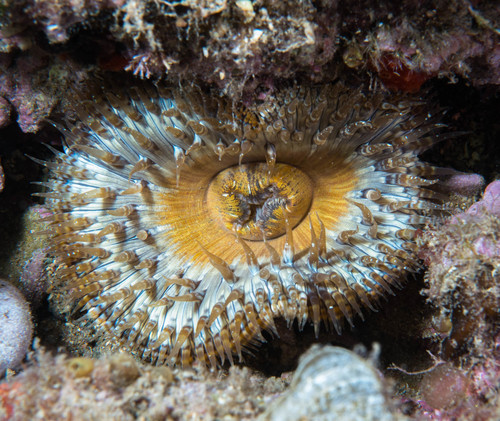
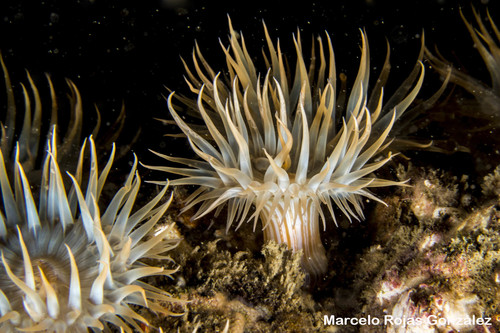
The base of Cylista troglodytes anchors itself in holes within rock, and is slightly wider than the organism’s column. The column is smooth and firm, reaching a length several times its width, and its upper section is covered in sticky suckers. The oral disc is typically flat, finely patterned, and surrounded by four or five rings of numerous short tentacles; the longest tentacles are positioned closest to the mouth. The mouth sits on a small raised mound at the center of the oral disc. The organism’s overall color ranges across dark, muted shades of olive green or brown, with vertical stripes along the column. Radial stripes on the oral disc form fine patterns of grey, white, and black, while the tentacles are translucent and marked with alternating white and grey bands. Each tentacle has a distinctive black mark shaped like a Roman capital letter “B” at its base. Gravel pieces and shell fragments often adhere to the upper portion of the column. Fully grown, the column can reach a diameter of 1 inch (2.5 cm) and a length of 2 inches (5 cm), though most individual specimens are much smaller than this maximum size. Cylista troglodytes occurs in coastal areas of the northeast Atlantic Ocean, the North Sea, and the Mediterranean Sea. It is common between the tide marks around British coasts, but is rarely noticed because it has good camouflage and often hides in cracks, under overhangs, in rock pools, under seaweed, among mussels, or is half buried in sand and mud with only its tentacles visible. In Morecambe Bay, England, it anchors to stones buried several inches below the surface of the area’s mudflats; sometimes it is not attached to anything, and lives freely. When disturbed, it can retract into a spherical shape and can no longer be seen from the surface.