About Cylindropuntia imbricata subsp. rosea (DC.) M.A.Baker
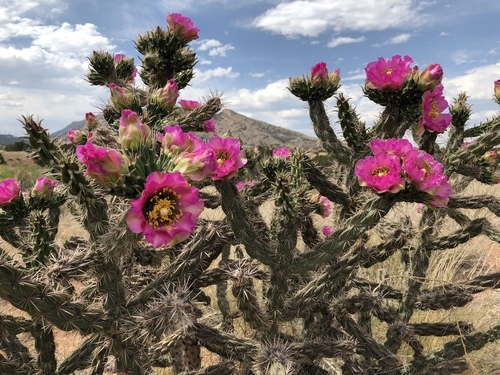
The above-ground portion of Cylindropuntia imbricata subsp. rosea is made up of highly branched cylindrical stems, with terminal stem joints measuring around 3 cm (1.2 in) in diameter. Unlike the joints of some other cholla species, these joints do not detach easily. The stems have a prominently lumpy (tubercular) texture, marked by a pattern of long oval bumps. Most plants reach a typical height of around 1 m (3 ft), but exceptional individuals can grow up to 4.6 m (15 ft) tall with a trunk diameter of 25 cm (9.8 in). The overall width of the plant is often similar to or slightly greater than its height.
Stems bear clusters of up to around 10 red to pink spines, which can reach 3 cm (1.2 in) in length. These spines are barbed and sharp enough to easily penetrate leather gardening gloves. Both stems and fruits also have many small detachable spines called glochids, around 1 mm (0.04 in) long, that can stick into skin. This taxon produces two types of flattened stem segments called cladodes: long plagiotropic cladodes, which bear flowers at their tips and drop off the plant after a few years, and long orthotropic cladodes, which mainly provide structural support and conduct water and nutrients, remaining attached to the plant permanently. Plagiotropic stems grow in a star- or crown-shaped pattern around a central orthotropic stem.
This subspecies blooms in late spring or early summer. Its flowers are purple or magenta, rarely rose-pink, and measure about 5 cm (2.0 in) across. The fruits are yellowish, have the same tubercular texture as the stems, and are shaped roughly like a truncated cone, with a hollow at the wider end where the flower detached; they are often mistaken for flowers. The plant retains its fruits through the winter, and the fruits are dry and mild in flavor, though Indigenous peoples of Arizona and New Mexico are recorded to have eaten them.
In addition to reproducing sexually, this tree cholla can also reproduce vegetatively when stem joints fall to the ground and take root. This allows the species to spread easily, and its spread is difficult to control. Animals help spread the plant further by excreting seeds and carrying stem joints stuck to their fur away from the parent plant; some cattle, called "cholla eaters", even learn to consume cholla fruits despite the spines' pain. Waves of invasion typically occur four to five years after drought combined with grazing, likely because this combination exposes bare soil where stem joints can successfully root.
The native range of this cane cholla covers arid regions of Nevada, Arizona, New Mexico, Colorado, Oklahoma, Kansas, and Texas in the United States, extending south into Durango, Zacatecas, and San Luis Potosí in Mexico. It grows at elevations between 1,200 and 2,300 m (3,900 to 7,500 ft) and is unusually cold hardy for a cactus, suited to USDA Zone 5A. In parts of its native range, commonly found just below the pinyon-juniper vegetation belt, it can grow abundantly in areas surrounded by low grasses and forbs that stay brown for most of the year. In these areas, chollas stand out as the only tall, green plants present. Individuals may grow together to form thickets, or be spaced a few times their width apart in open "garden" formations. This species is a noxious invasive in Australia, where it occurs in former mining sites and along watercourses. It is known locally by the common names Devil's rope cactus or Devil's rope pear, and is classified as a declared noxious weed in New South Wales. It also occurs in Queensland, the Northern Territory, Victoria, and South Australia.
The fruits of this taxon are eaten by a range of wild birds and mammals, including pronghorn, desert bighorn sheep, and deer. The thorny plants provide protective cover that small animals can use to escape predators. The leafcutter bee Lithurgus apicalis has been observed pollinating its flowers.
This plant is sometimes grown as an ornamental. When dead stems decay, they leave behind hollow wooden tubes marked with a pattern of lengthwise slits, which are sometimes used to make walking canes or decorative curios. The Roman Catholic Penitentes of New Mexico historically tied fresh stems to their bare backs during Holy Week processions. The Zuni people use Cylindropuntia imbricata varieties for ceremonial purposes.