About Cylindropuntia fulgida (Engelm.) F.M.Knuth
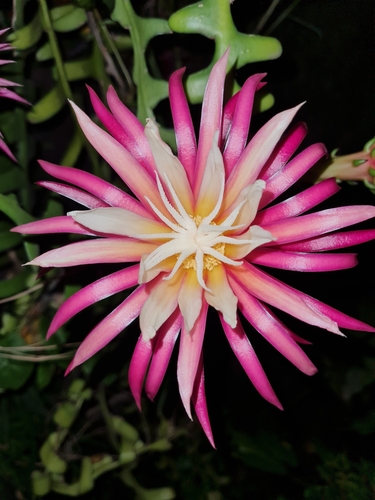
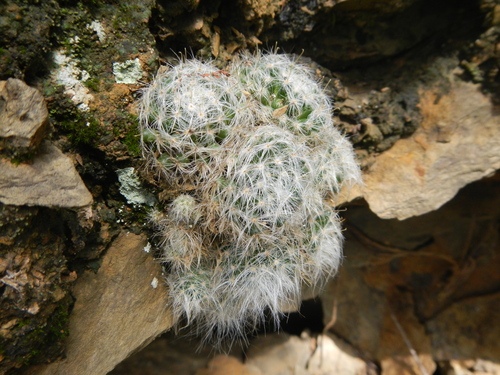
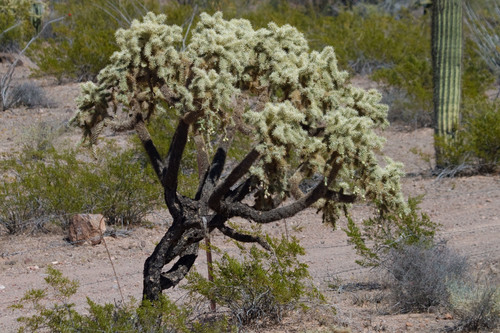
Cylindropuntia fulgida grows at elevations between 300 and 1,000 m (980 to 3,280 feet). The common name "jumping cholla" refers most specifically to this species, though it is also used as a general term for all chollas. Jumping cholla is an arborescent (tree-like) cactus with a single low-branching trunk. It often reaches heights of 4 m (13 feet), and produces drooping branches that bear chained fruit. Its stems are light green and heavily tuberculate, with small, wart-like tubercles that measure 6 to 9 millimetres (1⁄4 to 1⁄3 in). Groups of these plants form large stands, or cactus forests, that can cover many hectares. The species' flowers are white and pink, streaked with lavender, and roughly 2.5 cm (1 inch) wide. Flowers grow at the tips of stem joints, or on the tips of old fruit, and bloom in mid-summer. According to naturalists Henry and Rebecca Northen, a notable quirk of this species is that its flowers open at exactly 3:00 p.m. solar time, so it can be used to set a watch. Most of the fleshy, green fruits are sterile; they range in shape from pear-shaped to nearly round, are wrinkled, and bear a small number of spines. The fruits are typically about 4 cm (1+1⁄2 inches) long, and often produce new flowers the following year, which add new fruits to those from previous growing seasons. These hanging chains of fruit give the species its other common name, "hanging chain cholla". Like other cacti, its leaves have been modified into spines. Each areole produces 6 to 12 spines. Young branches are covered in 2 to 3 cm (3⁄4 to 1+1⁄6 inches) silvery-yellow spines that darken to gray as they age. These spines form a dense layer that hides the underlying stems. Slower-growing or older branches have sparser, shorter spines. As spines fall off older parts of the plant, rough, scaly brown-black bark is revealed, which becomes rougher with age. The largest part of the jumping cholla's range covers all of Sonora, Mexico, except the Sierra Madre Occidental cordillera in the east; the range also includes northern Sonora, and the major islands of Tiburon and Isla Ángel de la Guarda. In the Southwestern United States, its range extends into the Colorado Desert of California, and into Arizona. In Arizona, it occurs south and southwest of the Mogollon Rim Arizona transition zone, and is found in a small number of select locations in the northwest-central Sonoran Desert of Arizona. It also reaches the northeast section of the Mojave Desert in southern Nevada and southern Utah, and the far southern section of the Great Basin Desert in southern Utah. It grows just south of the east-west section of the Bill Williams River, east of the Colorado River in the Yuma Desert, and also occurs in parts of the Eastern Plains of Colorado. The ground around a mature jumping cholla is often covered with dead stems. New young plants grow from stems that have fallen from the adult plant. Even the lightest touch often leaves fragments of the cactus stuck to a person's clothes, which are usually only noticed later when the person sits or leans on them. The detached stem segments typically attach to desert animals, which disperse them over short distances. Extinct hairy megafauna that lived during the last ice age may have contributed to the species' historically wider dispersal this way. During droughts, animals including bighorn sheep and desert mule deer rely on the plant's fruit for food and water. Because jumping cholla grows in the inaccessible, hostile terrain of the desert, its populations are stable. Cactus wrens are known to build their nests in jumping cholla stands.