About Cylindropuntia echinocarpa (Engelm. & J.M.Bigelow) F.M.Knuth
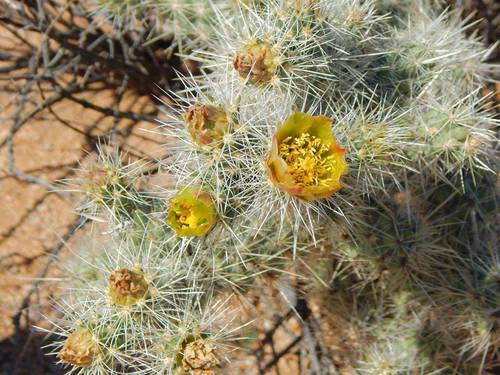
Silver cholla (Cylindropuntia echinocarpa) is a large cactus that grows as a shrub or takes on a tree-like form, reaching heights over 0.5 to 2 meters (1.6 to 6.6 ft). Its stems and branches are made up of cylindrical green tubercles, or segments, that grow up to 1.5 cm wide and just under 1.0 cm tall. The elliptical areoles, which start white or yellow and turn gray with age, bear prominent yellow glochids that measure 3 to 4 millimeters long. Nearly all areoles have spines, with 6 to 22 spines per areole. Each fleshy tubercle bears up to 20 long, straight, grayish or yellowish spines that can be nearly 4 cm long. A key identifying feature that separates this species from the similarly distributed buckhorn cholla (Cylindropuntia acanthocarpa) is that the width of silver cholla's tubercles is less than twice their length. The spines interlock to completely cover the shoots; they range from erect to spreading in orientation, are colored white to brown (sometimes darker), and measure 2.5 to 5 centimeters long. Bristle-like spines are also often present, and the spines' sheaths are white at the base and golden yellow above. The flowers of silver cholla are most often greenish yellow, but may sometimes be pinkish or brownish. The fruit is lumpy, spiny, and tan in color, with white seeds and a strong foul odor similar to rancid butter. It grows up to 2 to 2.3 centimeters long. Very few fruits mature, and many immature fruits can commonly be found lying on the ground below the plant. This plant reproduces mainly by seed, but detached tubercles can also take root to form new plants through asexual reproduction. Cylindropuntia echinocarpa is native to the Southwestern United States and northwestern Mexico, specifically the Mexican states of Baja California and Sonora. It grows in the Sonoran Desert, Mojave Desert, and Colorado Desert, across the U.S. states of California, Nevada, Utah, and Arizona. It occurs in semi-desert, grassland, and forestland habitats at altitudes between 50 and 1700 meters. It is commonly found in desert dry wash, creosote bush scrub, Joshua tree woodland, and pinyon-juniper woodland plant communities. Its range extends from Mono County in California down to the Baja California Peninsula.