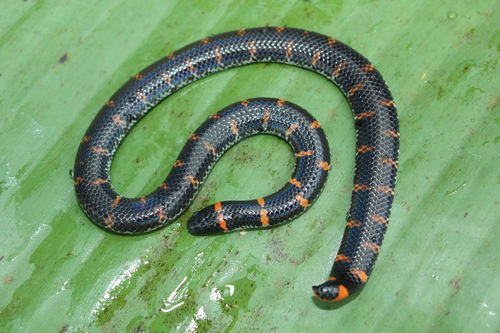
About Cylindrophis ruffus (Laurenti, 1768)
Cylindrophis ruffus was first formally described by Laurenti in 1768. Adult individuals of this species can reach a total length of 39 inches, which equals 1 meter. This snake has smooth dorsal scales arranged in 19 or 21 rows, with 186 to 245 ventral scales. The ventral scales are not quite twice as large as the adjacent dorsal scales. The anal plate of C. ruffus is divided, and it has between five and 10 subcaudals. Unlike many other snake species, C. ruffus has a limited gape size. It primarily preys on long, thin animals, specifically snakes, caecilians, and eels. This species has a geographic range that covers Myanmar and southern China, including Fujian, Hong Kong, and Hainan Island. Its range extends south through Vietnam, Laos, Cambodia, Thailand, and the Malay Peninsula, and continues into the East Indies as far as Indonesia, where it is found on the Riau Archipelago, Sumatra, Bangka, Borneo, Java, Sulawesi, Buton, and the Sula Islands. The type locality originally given for this species is "Surinami", which is likely an error.


