About Cylindromyia brassicaria (Fabricius, 1775)
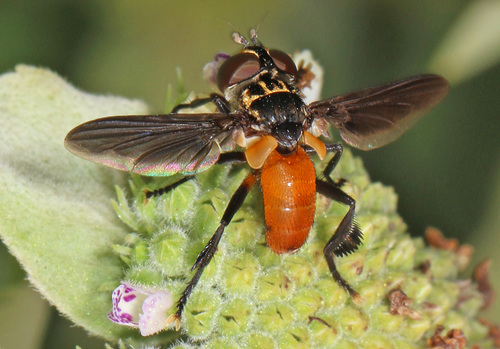
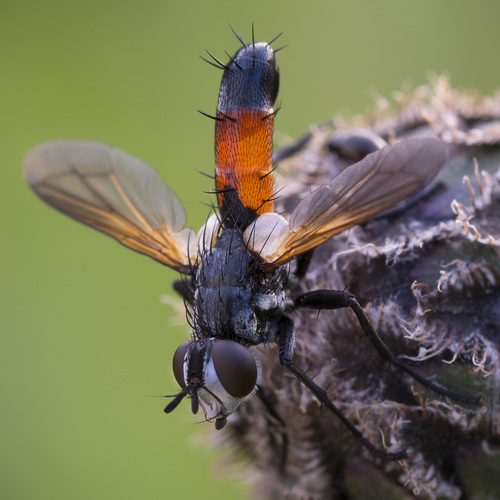
Cylindromyia brassicaria is a fly that reaches an adult body length of approximately 9–13 mm (0.35–0.51 in). The base body color of these flies is grey-black, but the middle section of the abdomen is reddish-orange. A black wedge-shaped marking extends into this reddish-orange abdominal area. All bristles on these flies are black. Their wings are transparent, with orange coloring along the inner leading edge. White lobes are located below the wings. In females, red-brown eyes are separated by a white area that has a black center line. Tergites 4 and 5 are black; a black longitudinal stripe may also be present on tergite 3. The abdomen has no discal bristles. The ventral side of tergite 2 only bears hairs, and is often almost completely bare. The back of the head only has white hairs. In males, the hind legs and the ventral side of tergite 3 have typical short hairs. In females, tergite 4 only has 4 marginal bristles. This species is found in the Palearctic realm, including Central Asia (Turkmenistan), multiple regions of China (Central East, Nei Mongol, Northeast, Qinghai & Xizang, Xinjiang), and most of Europe. Its European range covers Western Europe (Austria, Belgium, Channel Islands, France, Germany), Central Europe (Belarus, Czech Republic, Estonia, Hungary, Latvia, Moldova, Poland, Romania, Slovakia, Ukraine), the British Isles, Scandinavia (Denmark, Finland, Norway, Sweden), and Southern Europe (Albania, Andorra, Bulgaria, Corse, Croatia, Greece, Italy, North Macedonia, Portugal, Serbia, Slovenia, Spain, Turkey). The typical habitat of Cylindromyia brassicaria consists of meadows and hedgerows.